Get Full Government Meeting Transcripts, Videos, & Alerts Forever!
Get email alerts on the Clean Power Rfp topic
No spam. Unsubscribe anytime.
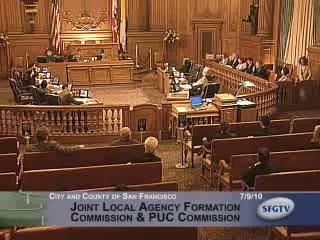
LAFCO and SFPUC review near‑final Clean Power SF RFP; debate centers on in‑city generation, RECs and timing
Summary
SFPUC staff presented a near‑final draft of the Clean Power San Francisco RFP proposing a 5‑year minimum contract (renewable up to 20 years), a 51% city 'green' portfolio goal and a separate RFO for in‑city generation to manage CEQA timing. Commissioners and public commenters pressed for stronger in‑city build requirements, job guarantees, and clearer limits on renewable energy credits.
A joint meeting of the San Francisco Local Agency Formation Commission (LAFCO) and the San Francisco Public Utilities Commission (SFPUC) heard a redraft of the Clean Power San Francisco request for proposals (RFP) and extensive questions on how the city will balance immediate program launch with developing in‑city renewable generation.
Barbara Hale, SFPUC assistant general manager for power, told the commissions the draft RFP is near final and posted for public comment. "We are recommending that we have a 5‑year minimum contract duration with the possibility of renewal up to 20 years," Hale said, outlining seven RFP topics: the resource portfolio, a separate request‑for‑offer (RFO) process for city‑sited generation to address CEQA timing, renewable goals, treatment of renewable energy credits (RECs), target rates, customer enrollment, and protections against financial risk to the city.
Hale said the city intends a 51 percent "green" portfolio goal and will require California‑certified renewable resources where state rules apply; she added the RFP will discourage extensive reliance on RECs while allowing them as a cost‑effective tool if needed to meet rates. On pricing comparisons, staff plans to ask bidders to show rates that "meet or beat PG&E" using PG&E's historic generation‑rate growth (3.7 percent) as a comparison benchmark.
Commissioners pushed staff on several tradeoffs. Commissioner Borenstein said bundling long‑term contracts with voter‑authorized bonding could enable in‑city projects and near‑term job creation; Borenstein warned that separating project tasks could dilute the ability to finance and build city generation. Hale replied the RFO process will let the city commit long‑term revenue streams to projects while allowing an earlier launch of the CCA program so customers are served before all CEQA work is finished.
On RECs, Commissioner Viator and Commissioner Ellis pressed for clearer, less‑vague language than "extensive reliance discouraged." Hale said state law requires 20 percent of the resource base be California‑compliant renewables and that the RFP team can emphasize a preference for bids that help reach the city's 51 percent green goal without setting a fixed ceiling on REC use in the initial draft.
Commissioner Moran asked about safeguards for the city’s financial exposure. Hale and SFPUC General Manager Ed Harrington described a proposed lockbox model: PG&E would continue billing and collecting for CCA customers, transfer revenues into a separate account, and the CCA counterparty would be paid from that dedicated stream—designed to limit recourse to other city funds.
Public commenters echoed commissioners’ concerns. Eric Brooks of the San Francisco Green Party and the Community Choice Energy Alliance urged that installed assets not be separated from the contract and called for 15–20 year terms, immediate full enrollment (no phasing) and stronger mandatory local‑hiring language. Spratt Rosecrans of Restore Hetch Hetchy asked staff to clarify whether San Francisco’s hydro resources count as "green" under state rules or under the city’s definition.
Hale said the RFP will be advertised this month, public comments are requested by July 15, proposals will be due in September, staff expects to qualify respondents in October, finalize a contract by the end of the calendar year, and target an initial program launch in the first quarter of 2011.
The discussion produced direction to staff to (1) refine RFP language on REC reliance and evaluative criteria, (2) retain minimum financial qualifications and fill‑in tables to clarify resource mix and pricing, and (3) continue public outreach before publication.