Get Full Government Meeting Transcripts, Videos, & Alerts Forever!
Get email alerts on the Political Activity Rules topic
No spam. Unsubscribe anytime.
City attorney’s office warns commissioners not to use government resources for campaign activity
Summary
Deputy/city‑attorney staff told the joint meeting that government officials and employees may exercise First Amendment rights but may not use government time, money, or premises for express advocacy; agencies may, however, publish objective analyses of ballot measures consistent with normal practices.
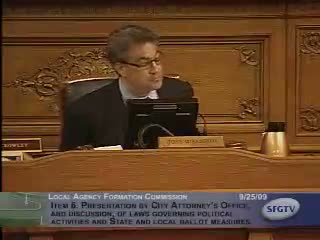
John Gibner of the City Attorney’s Office briefed the joint commission on limits that govern political activity by city officers, employees and agencies. Gibner said officials retain First Amendment rights but must not use government resources, time or premises for express advocacy for or against candidates or ballot measures.
Gibner explained that city resources include chambers, government telephones, computers, fax machines and copiers, and that use of those resources for campaign purposes—even to access a personal account from a government computer—can violate the rules. He said agencies may provide objective, factual analyses of measures and may publish reports in the same manner they normally communicate with the public, so long as the material does not cross into express advocacy.
He also outlined potential consequences: individual officers can face administrative proceedings before the ethics commission, civil enforcement actions brought by the city attorney or the attorney general, and in rare cases criminal penalties. Gibner cited a recent California Supreme Court case involving the city of Salinas that, while resulting in vindication for the city, illustrated the potential costs of litigation.
Gibner noted that the state’s fair political practices regime applies and that local agencies risk being designated a political committee if they spend over thresholds on express advocacy, which would trigger campaign‑reporting obligations. He answered commissioners’ clarification questions about using a city title in private advocacy and confirmed that staff may identify their city title provided the context makes clear they are not speaking in an official capacity.
The commission opened public comment on the briefing but recorded no speakers and filed the item.