Get Full Government Meeting Transcripts, Videos, & Alerts Forever!
Get email alerts on the Clean Power Sf Rfp topic
No spam. Unsubscribe anytime.
SFPUC and LAFCO back modified RFP for Clean Power SF, preserve preference for ordinance goals
Summary
The San Francisco Public Utilities Commission and LAFCO directed staff to issue a modified, preference‑based RFP for Clean Power SF that retains the ordinance’s renewable goals as preferred outcomes while allowing scoring flexibility to attract bidders; commissions also required close PUC–LAFCO coordination before the Oct. 16 joint review and Oct. 20 Board consideration.
The San Francisco Public Utilities Commission voted unanimously to adopt a modified, preference‑based request for proposals (RFP) framework for the city’s Clean Power SF community choice aggregation program, and LAFCO concurred in a parallel vote. The decision directs SFPUC and LAFCO staff to work together to refine RFP language and scoring so that proposals closest to the ordinance goals are favored while preserving flexibility to draw bidders.
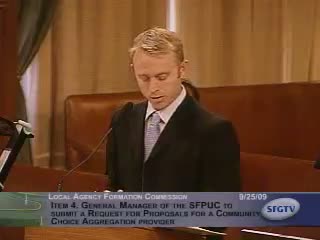
Municipal staff presented two RFP approaches: Option 1 would treat the ordinance’s performance elements as strict minimums (using language such as “must” and “shall”), while Option 2 would treat the same goals as targets that earn higher scores the closer a bidder comes to them. Mike Campbell, director of the SFPUC’s Clean Power SF program, told commissioners the two approaches were being advanced in parallel to meet an aggressive timeline and to give the Board of Supervisors a draft for review in late October.
Why it matters: the ordinance sets aggressive local goals (including reaching a majority‑renewables portfolio by 2017 and a specified in‑city generation mix) that advocates and some commissioners said should not be diluted. At the same time, staff and consultants warned that overly rigid requirements risked producing no market responses, which would delay implementation.
Campbell summarized the ordinance’s technical targets and explained tradeoffs: “We believe it is unlikely we’d be able to find a single bidder that would be able or willing to achieve the combination of all of those minimum criteria,” he said, pointing to the ordinance’s in‑city generation and portfolio targets. Staff proposed a modified Option 2 that preserves a clear preference for meeting the ordinance goals but scores near‑compliant responses rather than rejecting them outright.
LAFCO staff echoed that approach and said the RFP drafting and scoring language is critical. Ms. Miller (LAFCO staff) said the ordinance “is built with flexibility” but that how that flexibility is written into the RFP will determine whether responses are robust and whether the city preserves the program’s original intent.
Public commenters and community advocates urged tighter minimums or a middle “1.5” approach that would keep the three‑leg structure of the local portfolio intact (local solar, distributed generation and wind) and add stronger incentives for local assets and local hiring. Eric Brooks of the San Francisco Green Party said Option 2 as drafted was “far too lax” and warned that an open RFP could produce proposals that sacrificed the local renewable mix in favor of other configurations.
Outcome and next steps: the PUC adopted the amended resolution directing staff to (a) finalize an RFP based on Option 2 as modified by today’s discussion, (b) ensure that any respondent fully compliant with Option 1 minimums cannot be outscored by a noncompliant bid, and (c) convey strong preference for proposers that meet all goals. The commission will present the revised RFP to the joint GAO/LAFCO review on Oct. 16 and the Board of Supervisors on Oct. 20. LAFCO approved a parallel motion to concur and to participate closely in drafting and scoring prior to those dates.
What remains unresolved: staff said it will return with specific scoring language and any proposed ordinance amendments if needed. City counsel and deputy counsel indicated that certain edits might require either a resolution or an ordinance change, which could affect timelines and potentially add a short delay. The commissions directed staff to work with retained consultants and each other to have a draft ready for the scheduled joint review.