Get Full Government Meeting Transcripts, Videos, & Alerts Forever!
Get email alerts on the Renewables Costs topic
No spam. Unsubscribe anytime.
Consultant: out-of-city wind often lowest-cost after transmission; GES presents Task 3 findings
Summary
GES presented Task 3 preliminary analysis showing out-of-city wind resources generally offered the lowest levelized cost of electricity (LCOE) over 20 years; consultants cautioned that transmission/wheeling (~$15/MWh) and interconnection upgrades affect delivered cost and must be refined in Task 4.
Glenn Walker of GES briefed the Local Agency Formation Commission on Task 3, which compared levelized costs of out-of-city renewable resources and added transmission estimates to make delivery-cost comparisons with in-city options.
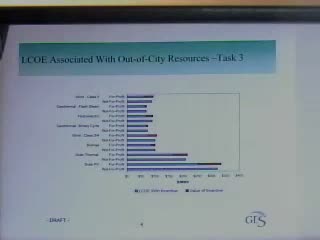
Walker summarized the firm’s findings: “wind resources provide the lowest cost of electricity over a 20 year period,” and said that when a transmission or wheeling cost (estimated around $15 per megawatt-hour) is added to out-of-city resources, many out-of-city options nevertheless remain less expensive than in-city alternatives because of better siting and higher capacity factors.
The analysis examined utility-scale solar PV, solar thermal, wind, incremental hydro (upgrades to existing facilities), geothermal and biomass using midpoints of typical installation costs. Walker said levelized costs in the study ranged from roughly $60/MWh up to about $300/MWh depending on technology and financing structure.
Commissioners asked whether the report’s cost comparisons incorporated transmission costs and nearby site options; Walker said slide 7 adds a transmission component and that Task 4 will refine wheeling and interconnection costs. He also acknowledged some in-city resources (e.g., geothermal or biomass) may not be feasible and noted that larger-scale wind farms sited outside the city often benefit from higher capacity factors and economies of scale.
Public comment raised environmental cautions: Eric Brooks (San Francisco Green Party) warned that some hydropower options that require raising reservoirs can produce CO2 releases and urged minimizing biomass and biofuels with problematic supply chains. Other commenters asked GES to analyze the Transbay cable and specific out-of-city projects such as Rio Vista Wind Farm to assess sourcing and environmental justice implications.
Next steps: GES will deliver the Task 3 draft (noted as due tomorrow in the presentation), staff will incorporate feedback on PV prices, steam-loop assumptions and biogas sourcing, and Task 4 will refine transmission/wheeling cost estimates and interconnection considerations.