Get Full Government Meeting Transcripts, Videos, & Alerts Forever!
Get email alerts on the Renewable Potential topic
No spam. Unsubscribe anytime.
GES report: San Francisco has modest in‑city solar and CHP potential; many renewables cost more than wholesale power
Summary
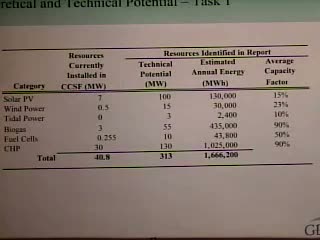
Consultants from GES told LAFCO that San Francisco's technical potential favors solar PV and combined heat and power (CHP), with roughly 100 MW solar potential and about 140 MW CHP potential (including a ~50 MW downtown repowering). GES said many in‑city renewables have levelized costs above current wholesale benchmarks.
Glenn Walker of GES presented the technical and economic potential analysis commissioned by the SFPUC. "The city has managed to install approximately 7 megawatts," Walker said of existing solar installations and he estimated a technical solar potential in the city of about 100 megawatts, not counting Sunset Reservoir's upcoming project.
Walker listed six in‑city resource categories considered technically feasible: solar photovoltaic, wind (small‑scale and building mounted), tidal, fuel cells, combined heat and power (CHP), and biogas delivered from outside the city and used onsite. He said municipal wastewater treatment plants currently generate about 3 megawatts of biogas‑fueled generation and identified opportunities to incorporate biogas procured from elsewhere via pipeline for additional capacity.
On economics, Walker explained the 20‑year levelized cost of electricity (LCOE) analysis. He reported that many renewable options in the city produce LCOEs in the neighborhood of $100–$120 per megawatt‑hour, while his wholesale market benchmark (Northern Path 15 levelized forecast) was about $70/MWh. Walker noted the analysis did not monetize externalities such as pollution reductions and that ownership structure matters: for‑profit project ownership that can use IRS tax incentives currently tends to yield lower LCOEs than not‑for‑profit ownership in the model.
The consultant highlighted a potentially significant single project: repowering the downtown steam loop and the Jesse Street Station (currently NRG‑owned), which could provide on the order of 50 MW and would materially increase CHP potential. Commissioners asked for clarifications about which resources counted as in‑city versus out‑of‑city; Walker and staff said subsequent tasks will analyze out‑of‑city resources and compare economic potential across locations. The draft GES report was in internal review and staff expected to make the draft public the following week; LAFCO advisers requested access for review before finalization.