Get Full Government Meeting Transcripts, Videos, & Alerts Forever!
Get email alerts on the Sunset Reservoir Ppa topic
No spam. Unsubscribe anytime.
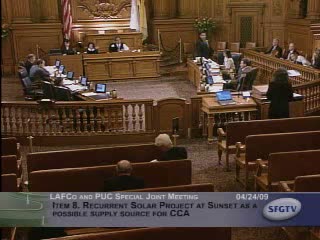
Proposed 5 MW Sunset Reservoir solar PPA draws scrutiny over costs, buyout timing and jobs
Summary
SFPUC staff presented a proposed 25-year 5 MW solar power purchase agreement at Sunset Reservoir with Recurrent Energy at about $0.235/kWh; commissioners and community groups pressed for more financial analysis, options for earlier city buyout, stronger local-hire and workforce guarantees, and exploration of public financing alternatives under Prop H.
The San Francisco Public Utilities Commission outlined a proposed 25-year power purchase agreement (PPA) with Recurrent Energy to build a 5-megawatt solar array at Sunset Reservoir, a project staff says could help demonstrate local renewable capacity for a future Clean Power SF CCA program.
Assistant General Manager for Power Barbara Hale told commissioners the PPA would deliver the solar project's renewable attributes and electricity to the city at an annual cost of about $1,870,000 and a kilowatt-hour price of roughly $0.235. Hale said the contract contains two buyout options for the city at years 7 and 15 and that the PPA structure allows Recurrent to capture federal tax benefits, which reduce the project cost included in the quoted price.
Why it matters: Commissioners and supervisors stressed that a PPA for a city-owned resource should be evaluated in the context of CCA and longer-term ownership goals. Chair Mercarini and several board members questioned whether locking into a 25-year PPA at current market terms could undercut the city’s chance to own lower-cost assets later, since panel costs and other solar technology prices have been declining.
Commissioners asked whether the city could secure rights to acquire the asset more frequently than year 7 and 15. Recurrent Energy representative Matt Garlinghouse said the company was open to clarifying buyout mechanics but that financing markets and tax-structure constraints limited more-frequent buyout options: the banks that finance these projects and their tax counsel evaluate ownership structure under IRS rules and the market’s terms.
Hale said the city’s internal analysis showed that direct municipal financing of the project at prevailing borrowing costs would raise the cumulative cost materially (staff estimated a higher cumulative cost when modeled as a city-financed purchase), and that the PPA represented the least-cost route to bring online local renewables now. Todd Reitstrom, SFPUC’s CFO, reiterated that long-term access to capital markets and a strong credit rating would be necessary for broader city-owned renewables financed through Proposition H authority.
Community and labor groups at the hearing urged stronger local-hire and apprenticeship requirements and requested full disclosure of subcontractor compliance with city contracting rules. Several advocates asked LAFCO and the Board of Supervisors to require closed-session review of Recurrent’s financial pro forma so that policymakers could compare the PPA offer against a city-built alternative and quantify long-term value.
The PPA also includes performance provisions: Recurrent confirmed that payments are tied to delivered kilowatt-hours and that underperformance reduces payments. Advocates and some supervisors urged staff to add clearer policy commitments about pursuing buyout options if market or financing conditions make earlier purchase feasible, and to ensure that any project is structured so CCA customers can benefit directly from local renewable generation once a CCA is operating.
What happens next: The Sunset Reservoir PPA and related waivers and budget requests are being considered by the Board of Supervisors; SFPUC staff said they will continue to respond to requests for additional financial details, workforce commitments and procurement transparency.