Get Full Government Meeting Transcripts, Videos, & Alerts Forever!
Get email alerts on the Procurement topic
No spam. Unsubscribe anytime.
SFPUC reports two RFQ responses for Clean Power SF; staff lays out RFP, study and market-research timelines
Summary
SFPUC Clean Power SF director Mike Campbell told LAFCO the RFQ yielded two respondents (NCPA and Shell Energy), described market and procurement risks driven by regulatory and price uncertainty, and said the GES economic study and market research will inform an October RFP with responses due in December.
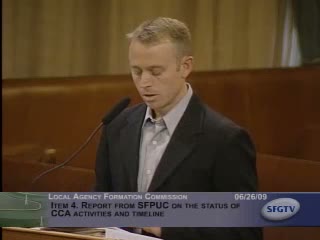
Mike Campbell, director of the San Francisco Public Utilities Commission's Clean Power SF (Community Choice Aggregation) program, updated LAFCO on procurement, technical studies and market research for the city's CCA effort.
Campbell said the RFQ produced two responses — from the Northern California Power Agency (NCPA) and Shell Energy — and that an independent four-person team is evaluating those proposals. "We received the responses from the NCPA... and Shell Energy," he said. Campbell described the two-response outcome as "not the robust response that I was hoping for" and cited economic conditions and market-rule uncertainty as likely deterrents to more bids.
He told commissioners that the economic component of the technical-potential study by consultant GES was near completion and would be presented at the next LAFCO meeting. Campbell said the program is conducting qualitative focus groups and an 800-person telephone survey to refine customer-participation assumptions and resource-mix preferences; he expects to issue the RFP in October with responses due in December, and said staff may add an RFP addendum in November to provide additional bidder information.
Campbell and commissioners discussed procurement structure options. Marin had allowed multiple firms to bid on different service components; San Francisco's ordinance currently envisions a single full-service provider. Commissioners asked staff to explore whether allowing multiple bidders for components could reduce bidder barriers without undermining oversight and project integration.
Why it matters: The RFQ response level and the market research will shape the RFP's structure and bidders' willingness to offer long-term fixed-price contracts — a key determinant of initial portfolio cost and local renewable procurement.