Get Full Government Meeting Transcripts, Videos, & Alerts Forever!
Get email alerts on the Clean Power Sf topic
No spam. Unsubscribe anytime.
San Francisco LAFCO presses SFPUC on Clean Power SF timeline as advocates warn delays will cost funding and local jobs
Summary
SFPUC staff told LAFCO the RFQ for the city's Clean Power SF program is slated for April and an RFP for October, but advocates and some commissioners said pace and transparency are inadequate and urged LAFCO to use its authority to accelerate work and secure federal and state funds.
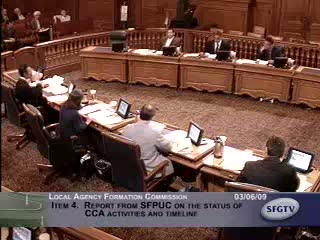
San Francisco's Local Agency Formation Commission on Friday pressed the Public Utilities Commission's staff on the timeline for the city's Community Choice Aggregation program, Clean Power SF, after residents and environmental groups urged faster action to capture state and federal funding.
Mike Campbell, CCA director for the San Francisco Public Utilities Commission, told LAFCO the agency plans to issue a request for qualifications by April and a request for proposals by October, and expects the bulk of a bottoms-up technical analysis to be complete by June. "By virtue of this approach, I think we'll be able to identify firms that are capable of providing the services that we need," Campbell said, while acknowledging some items in the timeline remain behind schedule.
The presentation followed an outline from Nancy Miller, LAFCO's acting interim executive officer, who reviewed prior steps — from a 2007 implementation plan adopted by the Board of Supervisors to joint RFQ work — and confirmed the SFPUC has placed $2.1 million in enterprise reserves to fund LAFCO's CCA activities (roughly $700,000 per year over three years). "We are on time with the schedule that we provided to the commission," Miller said of the RFP timeline but added that some deliverables are marked red and require attention.
Why it matters: LAFCO has both oversight and limited implementing authority under the ordinance that established Clean Power SF. Delays could mean missed windows to compete for grants and to secure local projects tied to federal stimulus financing, advocates warned.
Public advocates compressed that warning into a blunt appeal during public comment. "We have zero confidence in the SFPUC to move this forward and are insisting that LAFCO take over now with the RFP process," said Eric Brooks of the San Francisco Green Party, reflecting frustration repeated by the Sierra Club and other speakers who delivered thousands of petition signatures and letters urging immediate action.
Local Power, the consultant that drafted the program report presented to LAFCO, emphasized near-term project opportunities. Paul Finn said the report identifies approximately 575'00 to 780 megawatts of developable local capacity near San Francisco, highlights 106 megawatts of downtown waste-heat potential, and recommends pursuing access to the Transbay cable to expand renewable imports. The paper also described a "split-delivery" mechanism that could add low-cost Hetch Hetchy capacity to the CCA supply mix.
Commissioners pressed staff on specifics: which of the 17 elements of the program basis report are complete, how many consultants are under contract, how energy-efficiency public goods charge funds will be transitioned, and how San Francisco's opt-in/opt-out mechanics differ from Marin County's program. Several members expressed embarrassment that Marin had advanced more quickly in public outreach and documentation; Campbell said Marin's two-tier marketing and dedicated staff were factors but cautioned San Francisco's legal and program architecture differs.
Campbell and Miller both acknowledged risks. Campbell said the modern market's volatility and the limited pool of viable bidders could affect the timeline: "If we get only a handful of firms ... the rest of the timeline I think would be delayed." Miller added that some tasks are being coordinated with SFPUC consultants GES and others to create the technical and economic baseline that an RFP will require.
Next steps: LAFCO asked staff to return with additional program-basis materials and to set up a joint meeting with SFPUC; Miller said she has proposed April 17 or April 24 to SFPUC staff. LAFCO also continued a separate procurement item (see related article) to allow more time for commissioners to review procurement protocol and vendor contacts before awarding two contract tasks related to risk assessment and term-sheet drafting.
The meeting closed with requests from commissioners and the public for more frequent, local staff support at LAFCO so the body can manage multiple contracting and outreach tasks in parallel rather than piecemeal.
Ending: The commission expects to reconvene on CCA items at its next meeting and has scheduled a joint LAFCO-SFPUC discussion in April to align timelines and responsibilities.