Get Full Government Meeting Transcripts, Videos, & Alerts Forever!
Get email alerts on the Community Choice Aggregation topic
No spam. Unsubscribe anytime.
LAFCO presses to accelerate San Francisco Community Choice work, authorizes one senior hire
Summary
At its Jan. 23 meeting, San Francisco LAFCO reviewed consultant tasks for implementing Community Choice Aggregation (CCA), urged SFPUC to sign imminent contracts with GES, debated costly legal and financing tasks (H-bonds, Hetch Hetchy feasibility) and authorized the executive director to hire one senior staffer to advance the program.
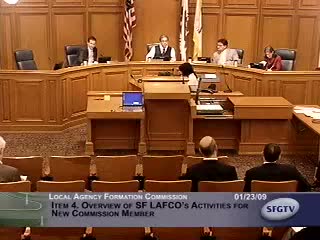
San Francisco LAFCO used much of its Jan. 23 meeting to press for faster implementation of Community Choice Aggregation, the local program intended to increase renewable energy procurement and reduce reliance on fossil-fired plants. Commissioners and staff debated which consultant tasks to fund immediately and gave the PUC a month to sign its task orders before LAFCO steps in.
The meeting’s central decision point focused on Item 5: a staff summary of consultant proposals for tasks A through G tied to the CCA program. Interim executive officer and legal counsel Nancy Miller told commissioners the SFPUC is “using basically the same consultants that we are” and recommended allowing SFPUC to finalize task orders for several items (notably tasks C and D and part of E) with GES. Miller said LAFCO should be authorized to contract with GES for the same work and price if SFPUC has not executed those contracts by the next meeting.
Commissioners pressed staff on higher-cost, legal-intensive tasks. Commissioner Hope Schmelzer raised whether the city attorney would accept outside counsel for bond work or financing questions; Miller said the city attorney ‘‘does use outside councils on a number of occasions, particularly on financing issues,’’ and that LAFCO can hire outside legal counsel as needed. The group singled out Task B (developing marketable H-bonds) and Task G (Hetch Hetchy feasibility) as items requiring more vetting because of cost and legal complexity. Miller noted one Task G proposal priced at $200,000 (Nixon Peabody legal opinion) and another at $75,000 (an engineering review), and commissioners asked for a clearer breakdown of what would be purchased for the larger fee.
SFPUC’s Barbara Hale said the utility has signed the GES task order and that staged deliverables are due: ‘‘The first work product that they are to bring in is due in 3 months,’’ she told commissioners, and the final deliverable is expected within roughly 8–9 months. Hale also said PUC staff is assessing whether the CCA contract structure will affect access to anticipated federal funding for renewables and efficiency.
Public speakers representing the Sierra Club, the Green Party and other groups urged LAFCO to approve the contracts immediately to capture federal stimulus and job-creation opportunities. John Rizzo of the Sierra Club said, ‘‘We can’t wait any longer. Global warming can’t wait. The economy can’t wait,’’ and asked commissioners to pass the contracts before the next meeting.
On staffing and implementation, after debate about budget authority and the timing of hires, commissioners amended Item 8 and authorized the executive director to hire one senior staff position to support CCA implementation while the formal city budget approvals proceed. Chair Ross Mercurimi framed the step as a way to ‘‘instigate the process’’ without waiting for the full board of supervisors’ budget cycle.
The commission also agreed to continue detailed discussion of the Local Power final program report and directed staff and the PUC to improve coordination; the Local Power representative said he had received a late set of SFPUC comments and that some items would need further reconciliation.
What’s next: Commissioners asked staff to present a concise, visual timeline of tasks tied to the GES workplan at the next meeting and gave SFPUC one month to execute the task orders it is negotiating with GES; if not, LAFCO’s interim executive officer is authorized to contract for the same scope and price so work is not delayed.