Get Full Government Meeting Transcripts, Videos, & Alerts Forever!
Get email alerts on the Cca Consultant Selection topic
No spam. Unsubscribe anytime.
San Francisco LAFCO and SFPUC face limited bidder field in search for CCA consultants
Summary
SFPUC staff reported only one firm responded to the utility's portion of a joint RFQ for consulting on San Francisco's Community Choice Aggregation program; LAFCO heard five candidate teams, raised concerns about LBE/12b compliance and political risk from incumbents, and directed staff to complete references and return with recommendations.
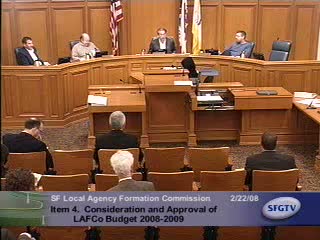
San Francisco's Local Agency Formation Commission (LAFCO) and the San Francisco Public Utilities Commission on Feb. 20 presented a slate of consultant teams for monitoring and advising the city's Community Choice Aggregation (CCA) program but made no selection after staff said the utility received just one responsive bid.
Laura Spanger of the SFPUC told commissioners the joint RFQ (issued Dec. 13) drew a strong field to LAFCO but only one full response for the PUC's portion: Local Power Incorporated. Spanger said the PUC will meet next week to decide whether to accept that single response, open outreach to encourage other bidders or seek minor changes to the PUC's LBE (local business enterprise) or "12b" domestic-partnership requirements that some firms cited as obstacles.
"We received one response, from Local Power Incorporated," Spanger said, describing extensive outreach, a pre-bid conference and a short extension of the deadline. She identified two common reasons firms declined to bid for the PUC role: difficulty finding certified LBEs to partner with and the paperwork and legal affirmation required for 12b compliance.
Why it matters: LAFCO has an advisory and oversight role under AB 117 in implementing CCA; the consultant team(s) will be asked to help draft RFPs, analyze economic and legal risk, monitor implementation and, potentially, support bond financing for local renewable projects.
At the meeting, five teams presented capabilities: Davis Wright Tremaine emphasized regulatory and litigation experience before the California Public Utilities Commission and Federal Energy Regulatory Commission; GES Engineers and Appraisers offered technical valuations and economic forecasting but said California legal work would require teaming with a law firm; Local Power, backed by Nixon Peabody and Booz Allen Hamilton, proposed an ambitious plan that aimed for a 51% renewable portfolio by 2017 and described the use of Prop H bond authority to finance new local generation; Navigant highlighted its prior work drafting CCA implementation plans and taking the San Joaquin Valley program to market; and several smaller consultants outlined niche finance or program-management services.
Local Power's lead presenter described the program as "very ambitious, very challenging, very complex" and said if successful it could be "transformative for the city," citing a multi-stage rollout and H-bond financing to support new renewable projects. Davis Wright told commissioners it could provide the legal and contract work needed for procurement and PUC filings, while Navigant said it had been selected by the San Joaquin Valley program to build an implementation plan and negotiate supplier contracts.
Staff also reviewed cost signals and timing. One bidder had proposed about $3.2 million for SFPUC services and roughly $5.6 million for combined SFPUC and LAFCO services over a three-year span; staff characterized that as a market benchmark rather than a finalized price. Commissioners questioned how LBE goals (LAFCO's 5% goal vs. SFPUC's 15%) and 12b requirements would affect the pool of eligible firms; staff said LAFCO required compliance at contract signing whereas SFPUC required compliance earlier, which may have discouraged some applicants.
Several commissioners emphasized process safeguards. Nancy Miller, LAFCO's interim executive officer and legal counsel, said staff was still checking references and recommended against unilateral contact between commissioners and applicants while the process is open. The board agreed to an embargo on such contacts and directed staff to return at the next meeting with reference checks and a suggested approach for assigning discrete RFQ tasks to one or more consultants.
No contract was awarded. The commission continued the consultant item to the call of the chair; staff said it expects to return with recommendations after completing reference checks and coordinating with SFPUC.
Provenance: Topic runs from the SFPUC status announcement (SFPUC report) through firm presentations and the staff'directed follow-up (transcript discussion SEG 388'SEG 3340).