Get Full Government Meeting Transcripts, Videos, & Alerts Forever!
Get email alerts on the Peak Oil Preparedness topic
No spam. Unsubscribe anytime.
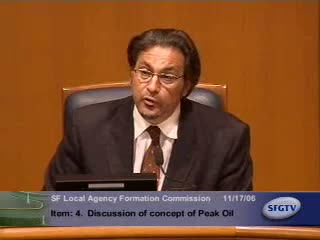
LAFCO backs moving PECOIL planning toward a city task force after civic presentations
Summary
Speakers from Sebastopol and local advocacy groups described municipal and community preparations for peak oil; the Department of the Environment proposed a briefing book and a consultant‑assisted task force model. Commissioners agreed to draft a resolution to the Board of Supervisors supporting formation of a task force.
LAFCO commissioners spent substantial time on PECOIL — peak‑oil preparedness — hearing presentations from municipal and civic actors and discussing potential next steps for San Francisco.
Larry Robinson, former mayor of Sebastopol, summarized his city’s two‑phase approach: a citizens advisory group studying municipal functions (water, sewer, public safety, city operations) and community‑wide vulnerabilities (food supply, transportation, social cohesion). Robinson said Sebastopol used a precautionary approach and prepared planning benchmarks for price and supply scenarios; the city is pursuing photovoltaics, biodiesel conversions for diesel fleets and targeted energy efficiency measures funded through low‑interest, federally guaranteed bonds.
Richard Katz of San Francisco Oil Awareness and the Post Carbon Group outlined peer‑city task‑force experiences in Portland, Franklin (NY), Bloomington and others. Katz described common elements — grassroots advocacy, government‑citizen partnerships, task forces with subcommittees (land use, transportation, food/agriculture, social services, economic development) — and urged San Francisco to adopt a similarly action‑oriented study and recommendation process.
Melissa Capri from the Department of the Environment proposed a practical starting point: produce a briefing book that pulls together existing city plans and studies (the climate action plan, electricity resource plan, sustainability plan, municipal greenhouse‑gas inventory and the San Francisco Food Alliance assessment). Capri recommended assembling a consultant‑supported task force that would run 5–6 meetings over six to eight months, use scenario analysis (price shocks, shortages, combined shocks) and prioritize municipal vulnerabilities, budget impacts and impacts to low‑income communities.
Commissioners and public commenters raised process questions: how to define task‑force membership; whether municipal operations should be treated as a sector in their own right; consultant scope and costs; and possible coordination with state officials. Public speakers urged an open process that includes underserved communities and recommended the Board of Supervisors be engaged to give the task force formal weight.
Chair Ross Mercarimi said he would forward a draft resolution of support from LAFCO to the Board of Supervisors, and commissioners agreed the matter should be coordinated with the Board. LAFCO did not adopt a final ordinance or compel a task force at this meeting, but the commission directed staff to prepare follow‑up materials and a draft resolution for the Board of Supervisors.