Get Full Government Meeting Transcripts, Videos, & Alerts Forever!
Get email alerts on the Citywide Wifi topic
No spam. Unsubscribe anytime.
LAFCO hears progress report on San Francisco’s citywide Wi‑Fi negotiations; privacy, revenue and municipal ownership debated
Summary
DTIS updated commissioners on ongoing negotiations with EarthLink (and Google), describing a 4‑year pilot approach, privacy protections (60‑day non‑aggregated location retention and opt‑outs), a proposed 5% gross revenue share, and digital inclusion pilots; public commenters urged a municipal ownership study and square‑mile pilots.
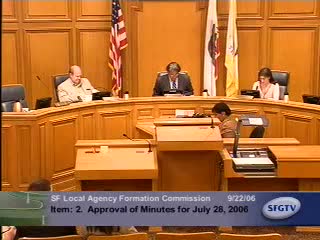
San Francisco’s Local Agency Formation Commission on Tuesday heard a status report from the Department of Telecommunications and Information Services on the citywide wireless broadband initiative and its negotiations with EarthLink and other potential providers.
Brian Roberts, senior policy analyst at DTIS, told the commission that negotiations with EarthLink remain active and that the department is posting weekly disclosures of negotiation documents at sfgov.org/techconnect. Roberts said the city is still deciding the formal contract vehicle — “it kind of falls in between a franchise and a major encroachment permit” — and that staff has negotiated a four‑year initial term with opportunities for renewal rather than an automatic extension.
The report focused on technical, privacy and financial elements of the prospective agreement. Roberts said privacy protections under discussion for the free tier include allowing anonymous access, limiting disclosure to third parties, and setting a retention limit of 60 days for non‑aggregated location information; he added that the network operator would hold access to that data but that users could opt out of location‑tracking services. "We've also addressed the major privacy issues that were brought up here including, anonymity on the free tier of service," Roberts said.
On finances, Roberts said the city is seeking roughly a 5% share of gross access charges and a revenue share on advertising associated with the free tier; he said an open‑book verification provision would be part of the package. The department has not finalized whether the city will receive a separate up‑front payment or periodic fees. "We are seeking 5% essentially of their gross revenue," Roberts said.
DTIS also described operational safeguards: a proof‑of‑concept pilot (a small‑scale technical test that could run up to six months) would precede a citywide rollout, and the RFP includes a 90% indoor coverage standard measured below 40 feet, which the department says recognizes limits for higher floors and complex indoor environments. Roberts said EarthLink would bundle customer‑premises equipment for paid service while other vendors might leave that equipment to users.
Digital inclusion was a central theme. Joaquin Alvarado, director of the San Francisco State Institute for Next Generation Internet, and Amy Tsung, DTIS project manager leading the digital inclusion task force, described community pilots in Bayview and Visitacion Valley, youth media and mobile‑device projects with SF State and the Bay Area Video Coalition, and coordination with public‑health outreach. "We are constantly battling the limitations of our own resources," Alvarado said, arguing wireless could connect culturally appropriate content to underserved households. Tsung said the task force has met four times and expects to release a draft citywide digital inclusion strategy for public comment in the coming weeks.
Public commenters pressed two themes: many urged studying municipal ownership as an alternative to contracting with a private vendor, and several asked for asset maps and valuations before finalizing compensation. Sydney Levy, program director at Media Alliance, cited a municipal‑ownership scenario her group studied that assumed a $10 million initial investment and projected about $2 million a year in net revenue over 10 years under conservative penetration assumptions. "If we manage to have a municipal system ... that ownership matters," Levy told commissioners.
Community wireless advocates asked for pilots to test real‑world performance. Ralph Mueller, director of SFLAN, urged a square‑mile pilot, as seen in Philadelphia, to determine whether service meets needs on higher floors and for video production use. Roberts said the department plans a limited proof‑of‑concept area before any citywide deployment.
Commissioners also discussed the role of municipal fiber. Staff and public speakers described fiber as complementary to wireless — necessary for backhaul and higher‑capacity services — and noted a separate fiber study commissioned by city supervisors is underway to assess longer‑term municipal fiber options and opportunities to deploy fiber when the city undertakes other public works.
No formal action was taken on the Wi‑Fi item at the meeting; commissioners said they would continue hearing public input and await the forthcoming budget‑analyst feasibility review on municipal ownership. With a quorum issue later in the meeting, the commission agreed to continue remaining agenda items to a future session and adjourned.
What’s next: DTIS said it will continue weekly disclosure postings of negotiation materials and the board of supervisors’ budget analyst will begin a municipal‑ownership feasibility review. DTIS also plans to release the draft digital inclusion strategy for public comment within weeks.