Get Full Government Meeting Transcripts, Videos, & Alerts Forever!
Get email alerts on the Community Choice Aggregation topic
No spam. Unsubscribe anytime.
San Francisco pushes ahead with Community Choice Aggregation as PUC and utilities spar over study and information sharing
Summary
LAFCO heard extended updates on the city’s Community Choice Aggregation (CCA) planning and a PUC-backed tidal-power study involving PG&E and Golden Gate Energy. Commissioners urged clarity about an MOU and whether publicly funded feasibility work and data would be shared with potential competitors.
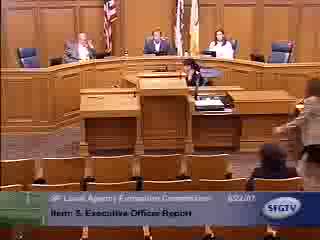
San Francisco officials said March 30 that work to set up Community Choice Aggregation is moving forward, but commissioners raised sharp questions about a mayoral press conference and a memorandum of understanding that pairs the city’s research with PG&E and a private company.
In an executive officer report and a subsequent PUC briefing, Barbara Hale, assistant general manager for power at the San Francisco Public Utilities Commission, said the PUC will issue an updated request for information and continue feasibility work on renewable resources. "The memorandum of understanding ... is intended to provide that mutuality of that sharing of information," Hale said, describing the document as a research collaboration that “doesn't make any commitments with respect to ownership” or specific technology.
Why it matters: San Francisco’s ordinance creates an early timeline for CCA steps — including an RFI with a 20-day clock under the ordinance — and a broadly ambitious renewables target. Commissioners urged transparency because the mayor’s office staged a press event announcing a separate study involving PG&E and Golden Gate Energy at roughly the same time the Board of Supervisors passed CCA legislation.
The board and commissioners pressed for more detail about timing, governance and whether public funds and PUC-funded feasibility work would be disclosed. One commissioner said the mayor’s announcement appeared to coincide with the board’s CCA action and pressed staff to explain why legislative members were not included in the MOU discussions. "We have to guard the fiduciary elements of our work and the fiduciary responsibilities in terms of the kind of investment we make," a commissioner said, arguing for counsel advice on confidentiality and competitive concerns.
Hale said PUC-funded work has informed an ongoing tidal-power feasibility study and that the PUC will brief commissioners and department staff on MOU content and the PUC’s study. She recommended issuing the RFI on schedule and using the resulting responses to shape the implementation plan and subsequent RFP. She added that the PUC is seeking budget approval to hire staff to manage implementation and communications for the program.
Context: Officials contrasted San Francisco’s ambitious renewable goal — discussed at about 50 percent of supply in some planning documents — with the San Joaquin Power Authority’s plan, which staff said targets about 20 percent renewables. Staff also noted that the San Joaquin filing to the California Public Utilities Commission was submitted recently and that utilities have voiced concerns about program elements such as exit fees.
What’s next: The PUC and executive staff offered to brief the Board of Supervisors and LAFCO more fully on the MOU, the tidal-power study and the RFI responses; LAFCO will serve in an advisory, conferring role during the first two to three years of CCA implementation. Commissioners asked counsel to review confidentiality and competitive implications before the city shares potentially proprietary data with parties that could be market competitors.