Get Full Government Meeting Transcripts, Videos, & Alerts Forever!
Get email alerts on the Transbay Cable topic
No spam. Unsubscribe anytime.
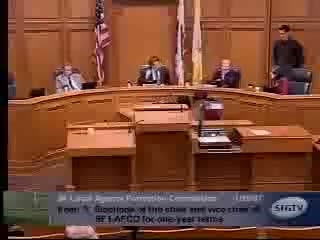
Transbay Cable hearing draws split testimony over 2010 schedule, reliability benefits and neighborhood impacts
Summary
LAFCO—s hearing on the Transbay Cable brought testimony from the California ISO, Port and proponents who said the 400 MW HVDC cable is needed by February 2010 for reliability; community groups and environmental advocates urged more review, questioned timing and stressed environmental justice and local alternatives.
The Local Agency Formation Commission convened a detailed hearing on the proposed Transbay Cable, a 400-megawatt high‑voltage DC transmission proposal that proponents say will create a second pathway into San Francisco and reduce operational risk.
Brad Benson of the Port of San Francisco described the port—s role as landlord and said any license the port negotiates would be subject to Board of Supervisors approval. Barbara Hale of the San Francisco Public Utilities Commission summarized the city—s electric resource plan and noted the Transbay Cable was not part of that plan when it was written, though it could interact with other city energy initiatives if the city elected to rely on its capacity.
Sam Winn of Babcock & Brown, representing the project sponsor, described converter‑station siting near Illinois Street and said the project has a certified environmental impact report and a proposed schedule that—if the port commission, Board of Supervisors and the BCDC issue approvals on an April timetable—could make the project commercially operational by February 2010.
Larry Tobias of the California Independent System Operator said the ISO—s technical studies support the Transbay Cable as the preferred reliability alternative and that, according to current modeling, the cable is needed as scheduled in February 2010 to avoid growing operational risk. He said costs and rate recovery arrangements have been addressed through ISO/FERC processes and would be allocated across the ISO control area.
Community speakers disputed that schedule and called for more public vetting of the ISO—s analyses. Representatives of San Francisco Community Power and other neighborhood groups said the city—s own electricity resource plan and aggressive energy‑efficiency and renewable programs could delay or reduce the need for the cable. They raised environmental‑justice concerns about clustering generation and transmission impacts near Potrero and urged the commission to press for stronger public‑benefit commitments from the developer.
Proponents said the cable provides an additional pathway into the city and would reduce transmission congestion and related emissions; they argued that permitting and construction timelines make earlier approvals necessary to meet a 2010 in‑service date. Multiple speakers said alternatives proposed by PG&E or other transmission upgrades face significant permitting hurdles and could not meet the ISO—s timing needs.
The commission closed public testimony and continued the item to the call of the chair to allow further review and to coordinate with pending port, Board of Supervisors and BCDC actions.