Get Full Government Meeting Transcripts, Videos, & Alerts Forever!
Get email alerts on the Municipal Wifi topic
No spam. Unsubscribe anytime.
LAFCO hears DTIS update on EarthLink Wi‑Fi talks; proof‑of‑concept, right‑of‑way and municipal options remain unresolved
Summary
DTIS told the commission EarthLink negotiations are underway but many contract details remain open; the city plans a proof‑of‑concept (6 months) before any citywide deployment (up to 18 months), and commissioners asked staff for a comparative matrix showing how Riverside, Minneapolis and other cities structured deals.
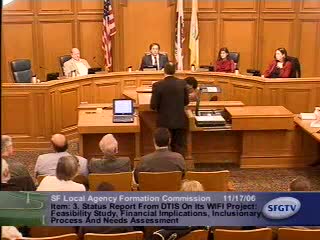
Ross Mercarimi, chair of the Local Agency Formation Commission (LAFCO), invited Brian Roberts of the Department of Telecommunications and Information Services to update the commission on negotiations with EarthLink for a proposed citywide Wi‑Fi network.
Roberts described the planned hardware and right‑of‑way footprint: pole‑mounted access radios and larger gateway nodes, with roughly 1,500 total nodes statewide in the proposal — about 1,000 access nodes and 500 gateway nodes, and roughly 10–15 backhaul/base‑station sites sited on rooftops or towers off the public right‑of‑way. He said decorative street poles would be avoided and that gateway nodes include backhaul radios that connect to towers not in the right‑of‑way.
On contracting, Roberts said most of the high‑level commercial terms have been negotiated but legal and agreement language remain under negotiation. He emphasized a proof‑of‑concept phase: a small test deployment the city will use to confirm right‑of‑way access, power arrangements and technical performance. Roberts said the proof of concept would run up to six months and a full citywide deployment would take about 18 months after a successful test; if the proof‑of‑concept fails, the city could terminate the agreement.
Roberts compared local discussions to other cities’ approaches. He said Minneapolis’ model involved an initial $2,000,000 payment and slightly more than $1,000,000 a year thereafter for 10 years, while Riverside’s annual revenue commitment averaged about $500,000 and tied to other telecom services. In those models a third party typically owns and operates the network under contract and the cities regulate through contract terms. Roberts said the city would provide a written matrix summarizing how other municipalities structured deals.
Commissioners probed municipal‑ownership options. Roberts said a municipally owned or hybrid model would be a separate project that requires direction from the Board of Supervisors; he cautioned that recent state legislation may have constrained local jurisdiction in ways that will bear on any municipal approach.
During public comment, Kimo Crossman urged the city be included as an anchor tenant and asked why municipal services (libraries, city hall, public safety) are being excluded from negotiations; he also raised concerns about change‑of‑control provisions that could transfer network ownership if EarthLink were sold. Don Eichelberger of the San Francisco Green Party asked whether potential health effects from increased Wi‑Fi radio frequency exposure have been addressed; Roberts did not present a health‑risk assessment and said he would follow up with documentation resources.
The commission closed public comment and agreed to continue the item at a future meeting, asking DTIS to provide a concise matrix describing how peer cities structured deals, and to return further cost and contract details for commissioners to review.
The commission did not record a formal vote on a contract at this meeting; staff said several contract terms remain open.