Get Full Government Meeting Transcripts, Videos, & Alerts Forever!
Get email alerts on the Racial Equity Plan topic
No spam. Unsubscribe anytime.
ADM presents phase 1 of Racial Equity Action Plan to Entertainment Commission
Summary
Office of the City Administrator staff presented ADM's phase 1 Racial Equity Action Plan, an internal, HR-focused 125-page report submitted Dec. 30 that proposes hiring, retention, discipline, leadership and boards-and-commissions reforms and recommends appointing racial-equity leads and an ADM racial equity group.
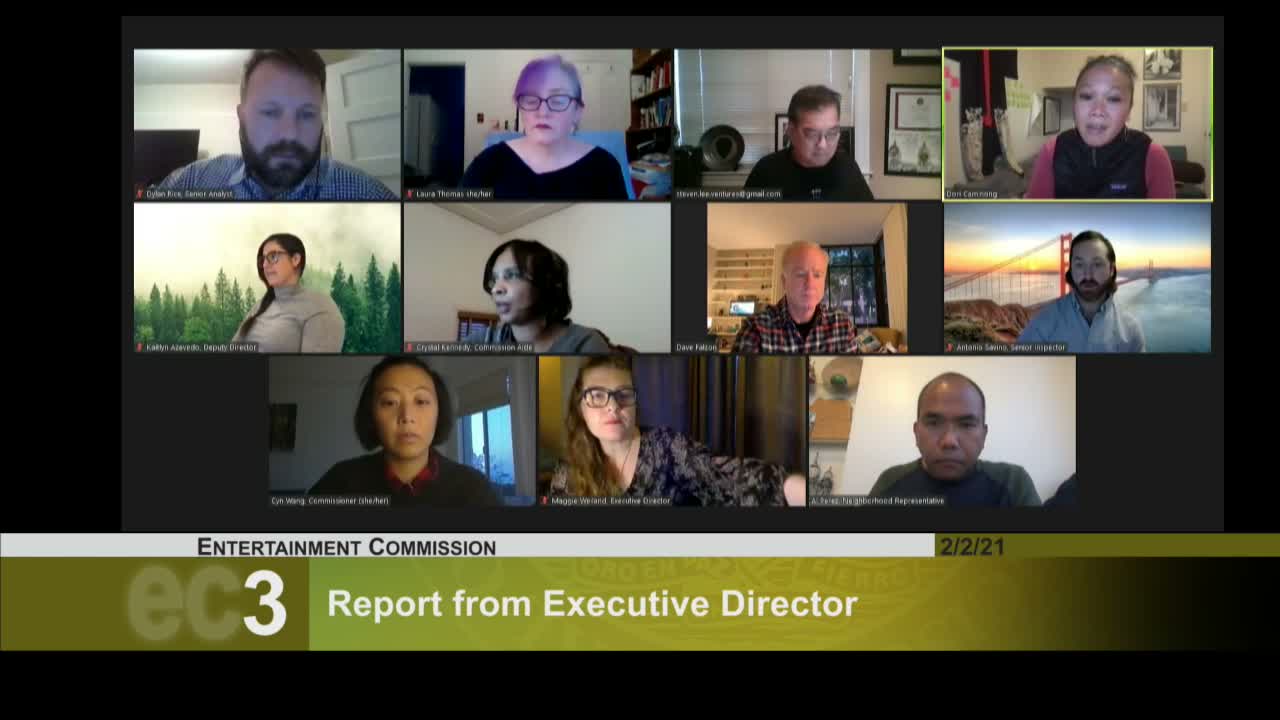
Marissa Rodriguez, director of the Office of Cannabis, and ADM staff presented the City Administrator's Racial Equity Action Plan (phase 1) to the San Francisco Entertainment Commission on Feb. 2. The plan, submitted Dec. 30 and about 125 pages long, focuses on internal HR reforms and next steps for implementing racial-equity work across ADM divisions.
"This report is very long and very detailed," Rodriguez said, noting ADM led phase 1 as an internal assessment and that phase 2 will be outward-facing once guidance arrives from the Office of Racial Equity. Deputy Director Eugene Hillsman and Associate Director Nikesh Patel described the plan's seven sections, which include hiring and recruitment; retention and promotion; discipline and separation; leadership and management; mobility and professional development; organizational culture; and boards and commissions.
Patel outlined hiring goals aimed at increasing BIPOC representation among new hires, especially those new to city government; working with the Department of Human Resources to move more Black and Hispanic employees into permanent civil-service appointments; speeding and making ADM hiring timelines more transparent; and creating targeted recruitment, mentorship and sponsorship programs. Hillsman emphasized retention and said ADM will use data analysis and exit-interview practices to identify barriers to promotion and retention.
Speakers highlighted disparities surfaced by an internal survey of ADM staff (more than 1,000 respondents). Rodriguez said 77% of staff agreed they felt valued, 70% that they felt comfortable expressing opinions, and 58% that they felt supported in career goals, but noted racial differences in responses, with Black staff reporting lower rates of feeling valued.
On boards and commissions, ADM proposed three priorities: make the appointment process more transparent; create peer support among advisory groups; and embed racial-equity outputs into committees' work. Initiatives include appointing a racial-equity lead within each advisory group, forming an ADM Boards/Commissions Racial Equity Group to meet several times a year, encouraging implicit-bias training for appointees, incorporating equity language into bylaws or rules of order, and running internal surveys of appointees to track perspectives.
Commissioners asked for clarification on acronyms and measurement. Commissioner Perez asked whether the goal is to match city demographics or pursue parity; Rodriguez said the objective is a good-faith effort to increase inclusion and opportunities rather than strict parity. Commissioners suggested the Entertainment Commission appoint a racial-equity lead and use the commission's March retreat to develop baseline metrics for permit-holder demographics and to consider how to measure progress.
ADM staff encouraged commissioners and stakeholders to read the full plan and executive summary on the City Administrator's racial equity landing page for detailed initiatives and timelines. The presentation concluded with staff noting that many implementation steps will require ongoing work with ADM Human Resources and additional guidance expected from the Office of Racial Equity.