Get Full Government Meeting Transcripts, Videos, & Alerts Forever!
Get email alerts on the Economic Recovery topic
No spam. Unsubscribe anytime.
Entertainment Commission hears Economic Recovery Task Force findings as San Francisco returns to purple tier
Summary
Assessor‑Recorder Carmen Chu told the Entertainment Commission that rising COVID‑19 hospitalizations and cases led San Francisco into the state's purple (widespread) tier on Nov. 28, triggering 24–48 hour rollback requirements. Chu outlined task‑force recommendations — including stimulus, job programs and shared‑spaces support — and warned that several relief funds are already oversubscribed.
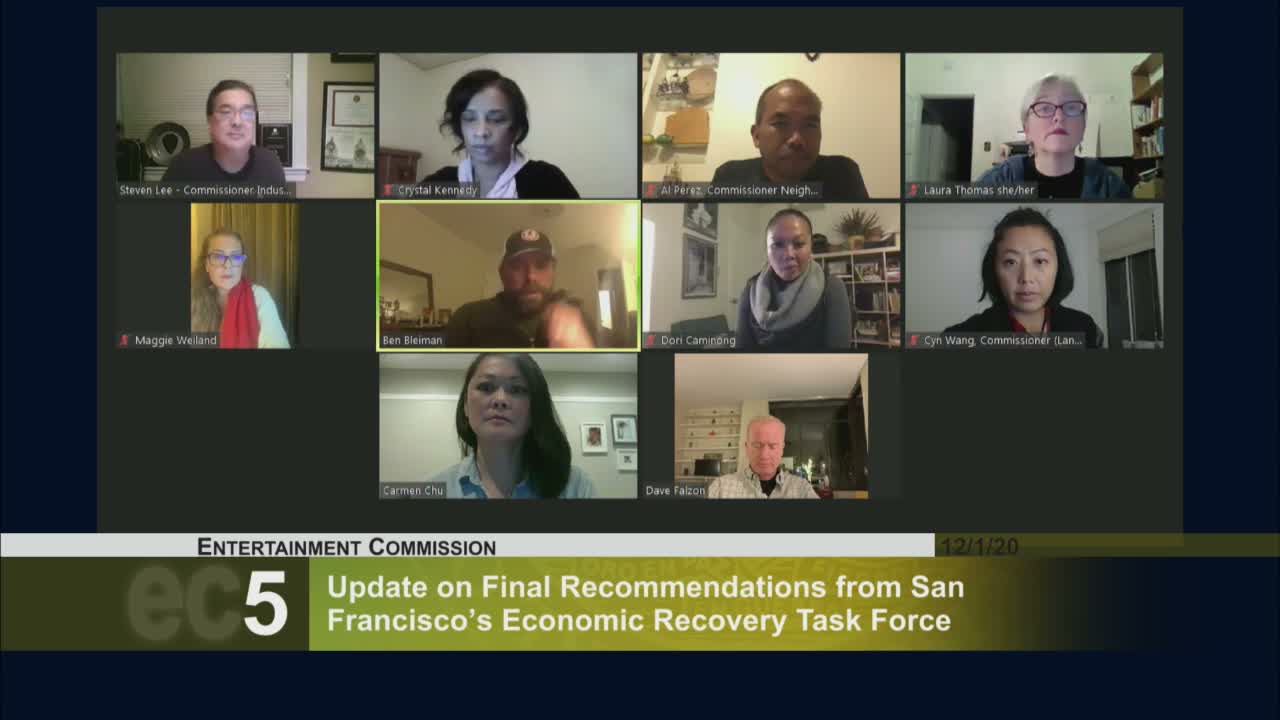
San Francisco’s Entertainment Commission on Dec. 1 received an update from Assessor‑Recorder Carmen Chu on the Economic Recovery Task Force’s final recommendations and on the city’s latest COVID‑19 metrics, as local officials scrambled to adapt to renewed state restrictions.
Chu told commissioners the city was assigned to the state’s widespread, or “purple,” tier on Nov. 28 and that move carries compressed compliance timelines. “We were recently put into the purple tier on November 28,” Chu said, and counties moved back into more restrictive tiers quickly; the state now allows tier revisions on any day and requires jurisdictions to comply within 24 to 48 hours for certain measures.
The presentation highlighted two especially weighty indicators: hospitalizations and case counts. Chu said cases per 100,000 in San Francisco were at about 16 and cautioned that hospital capacity — even with roughly one‑third of beds available in some units — would be exhausted quickly if the exponential rise in cases continues. She said the city is tracking testing, contact tracing and PPE availability as it considers reopening pathways.
Chu summarized the task force’s recommendations, grouping them into several “buckets” city leaders should prioritize: local economic stimulus (including infrastructure and permitting reforms), job connections and workforce consolidation (the city recently announced a $7.4 million investment in the JobsNow program), programs to support safe reopening (testing, PPE and shared outdoor spaces), and regulatory relief to preserve operations. She said some items — such as a legacy business program and targeted venue protections — are specifically relevant to arts, culture, hospitality and entertainment.
On existing funding, Chu said some relief channels are oversubscribed: the Art and Artist Relief Fund and certain cultural funding streams have reached capacity, and a Child Care and Education Fund was exhausted; however, she noted that passage of Proposition F may create new childcare funding down the line. Chu said the full ERTF report is posted online and staff will share links and follow up on specific budget questions.
Commissioners used the presentation to press for venue‑specific measures and clarity about what the city can do without state or federal action. Chu and staff advised that the commission can highlight a subset of recommendations to champion to the mayor and Board of Supervisors and that some items (for example, secure eviction relief or changes to state tax treatments) will need higher‑level action.
The commission will return the item for further consideration; staff agreed to flag which proposals are within local authority, identify existing programs that may already address some requests, and prepare a draft for discussion at the commission’s Dec. 15 meeting.
The presentation came as public commenters and commissioners expressed urgency for more support for venues that have closed and may reopen last, including pilot activations and neighborhood efforts to create COVID‑safe outdoor performance spaces.