Get Full Government Meeting Transcripts, Videos, & Alerts Forever!
Get email alerts on the Place Of Entertainment Permit topic
No spam. Unsubscribe anytime.
Entertainment Commission conditionally grants RS 94109 place-of-entertainment permit with limits on late-night extensions
Summary
The Entertainment Commission voted to conditionally grant a Place of Entertainment permit to RS 94109 (835 Larkin St.) after residents and the applicant negotiated hours and community conditions; the permit limits weeknight hours, requires a sound limiter and security identification, and restricts extra late-night extensions.
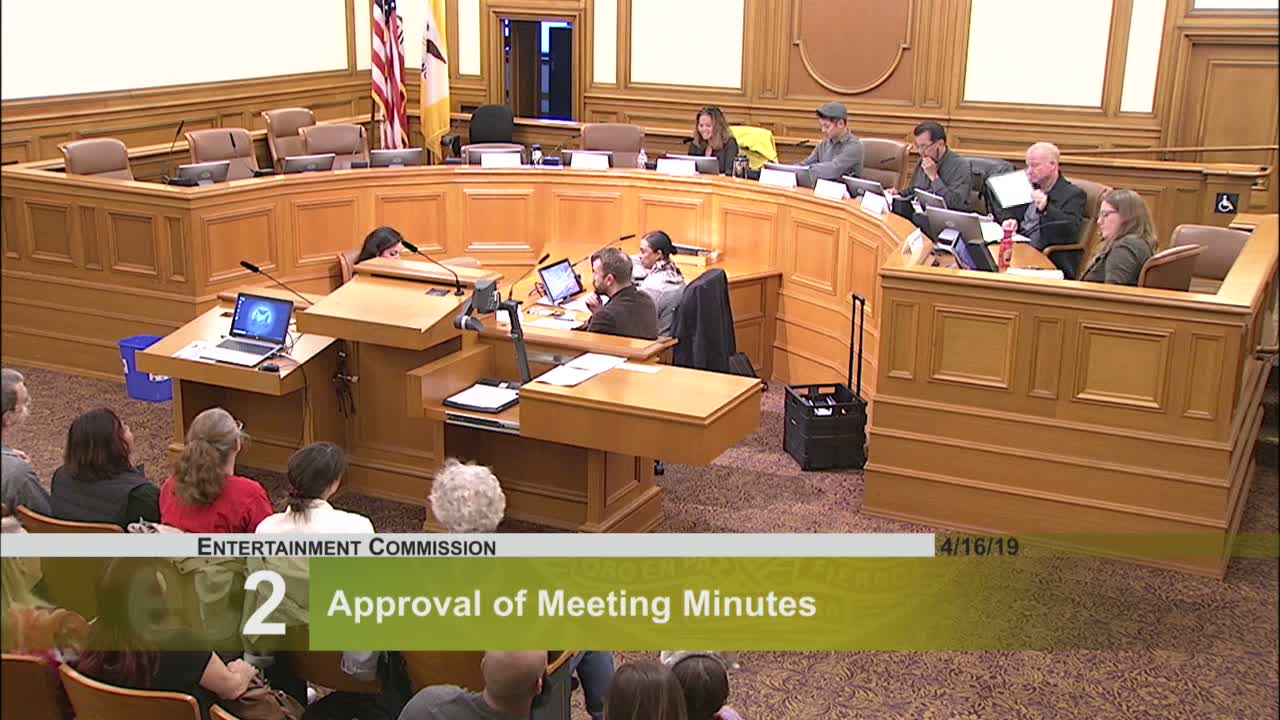
The San Francisco Entertainment Commission on Tuesday conditionally granted a Place of Entertainment permit to RS 94109, a Tenderloin record store and event venue, after a lengthy hearing that paired neighborhood concerns about noise with the applicant—s argument that special events are essential to the business—s survival.
The commission approved hours of operation limited to 11:00 p.m. Sunday through Thursday and 2:00 a.m. Friday and Saturday, with a limited number of late-night extensions per year as amended during debate. The permit carries standard good-neighbor requirements: security staff must wear distinctive clothing identifying them as security, the permit holder must use a sound limiter at all times to ensure compliance with approved sound limits, and the applicant must provide a monthly calendar of events to the Entertainment Commission, the Tenderloin police station and the Heartland Hotel.
—We have created a space for the arts and our events are the lifeblood of that work,— said Saurabh Haruni, owner of RS 94109, describing the store as both a retail business and a cultural venue. Haruni told commissioners the venue relies on private rentals and occasional late events to remain financially viable and that the business will provide contact numbers so neighbors can reach staff during events.
Heartland Hotel tenants and advocates urged stricter limits on late hours. —Noise and sidewalk traffic make it much harder for us to navigate our neighborhood,— said Kathy Vaughn, tenant organizer for the Heartland Hotel, which houses residents who the speakers said include people with disabilities and people in recovery. Vaughn said tenants negotiated a compromise with the applicant that would limit weeknight hours to 11:00 p.m. and asked commissioners to disallow additional floating late-night exceptions.
Commissioners framed the decision as a balance between protecting residents— right to quiet enjoyment and supporting small businesses that provide neighborhood vitality. —I want to make sure that we—re protecting the residents of the Heartland,— Commissioner Thomas said, while also noting a forthcoming grant program that could help small venues with soundproofing.
The commission—s motion included staff recommendations and a friendly amendment limiting the number of annual extensions; commissioners agreed the applicant could seek rehearing or reconditioning at any time and that staff would follow up on operational details including event calendars and enforcement protocol. The vote was recorded as an affirmative vote by Commissioners Perez, Thomas, Vice President Camino, Tan, Lee and Falzon; the chair announced the permit was conditionally granted and advised the applicant to follow up with the deputy director for next steps.
The record before the commission included extensive neighborhood outreach by the applicant: an online petition and in-store signatures and letters both supporting and opposing the permit. Tenderloin Housing Clinic was recorded in the staff file as opposing unlimited extensions and advocating for the 11:00 p.m. weeknight limit. The permit requires the venue to comply with the commission—s Good Neighbor Policy (GNP) and with any sound limits established during on-site testing.
The commission also discussed the practical limits of conditioning a permit on capital improvements such as building-level soundproofing; staff advised that time, place and manner conditions (for example, hours) are the lawful tool to address neighborhood impacts. The applicant said the full soundproofing estimate they received was beyond their budget and welcomed future grant opportunities to improve the venue—s sound attenuation.
Next steps: the applicant must complete any outstanding coordination with city inspectors, maintain the required contact mechanisms for neighbors and abide by the permit conditions. The commission indicated it would revisit the permit terms if community complaints or compliance issues emerge.