Get Full Government Meeting Transcripts, Videos, & Alerts Forever!
Get email alerts on the Outdoor Events Evaluation topic
No spam. Unsubscribe anytime.
City analyst outlines plan to simplify outdoor‑event permitting; recommends hub‑and‑spoke model
Summary
A city evaluation found complexity, lack of transparency and socioeconomic pressure are constraining outdoor street‑closure events; recommendations include a hub‑and‑spoke applicant hub, a single planning guide as a near‑term win, improved communications and sponsor matching.
The San Francisco Entertainment Commission received a status update on an evaluation of outdoor street‑closure events that recommended centralizing support for event producers, simplifying permit steps and increasing funding and sponsor connections to sustain neighborhood cultural traditions.
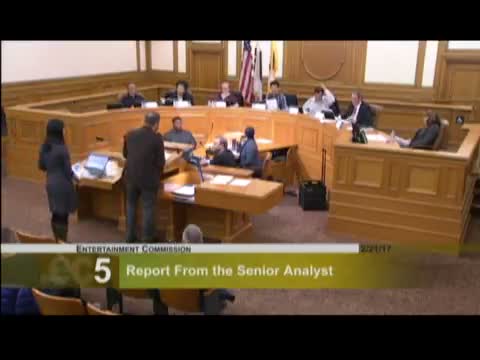
Dylan Rice, senior analyst for community and cultural events, said the report — done with Civic Bridge pro bono consultants — is intended to "lay the foundation for making policy and legislative change in order to help foster, sustain, and promote outdoor events." Consultant Joyce Chai summarized the evaluation’s methods and topline findings: the permitting process is complex, information is scattered across many bureaus and websites, and socioeconomic pressures are eroding some long‑running events.
Chai told the commission event producers face a fragmented process involving dozens of touchpoints: she cited a snapshot of "14 different bureaus, 10 different permits, 16 different approvals" and said that rework of permit submissions is common. The report flagged lost events — including the Tet Festival and a street‑food festival hosted by La Cocina — as examples of events that have closed amid funding and logistical pressures.
The report offered short‑ and long‑term recommendations. Short‑term, staff will produce an aggregated planning and permitting guide (a single PDF with links and checklists). Longer‑term ideas include a hub‑and‑spoke model to provide a single convener to shepherd applicants through the city process, a dynamic online portal, regular convenings and a sponsor‑matching effort to connect event producers to funding.
Rice said the evaluation will be read out to the mayor’s office as part of a Civic Bridge presentation; staff also plans working‑group convenings across departments. Commissioners generally praised the data collection and urged coordination with other city analyses, including a controller’s study of economic impact. Rice cited a controller figure saying outdoor events contribute "over $1,100,000,000 of direct and indirect economic impact on the city," and he said event counts have grown roughly 1.9% a year.
Commissioners and public commenters welcomed a planning guide and urged the commission to use data on economic impact when discussing resource needs with partner departments. Staff noted the Entertainment Commission’s limited authority over many permitting steps and framed the next phase as cross‑departmental collaboration rather than a unilateral commission initiative.