Get Full Government Meeting Transcripts, Videos, & Alerts Forever!
Get email alerts on the Nightlife Policy topic
No spam. Unsubscribe anytime.
Entertainment Commission to overhaul amplified-sound rules; asked to help lead LGBTQ nightlife working group
Summary
Staff told the San Francisco Entertainment Commission it will draft a major revision to the police-code sections covering amplified sound — including a new fixed-place permit — and will hold a public hearing targeted for Nov. 15. A Supervisor Wiener resolution asks the commission and OEWD to convene an LGBTQ Nightlife and Culture Working Group and deliver a strategy within six months.
The San Francisco Entertainment Commission was briefed on a package of proposed changes to the police code that would rewrite how the city regulates amplified sound for fixed places and venues with indoor/outdoor spaces.
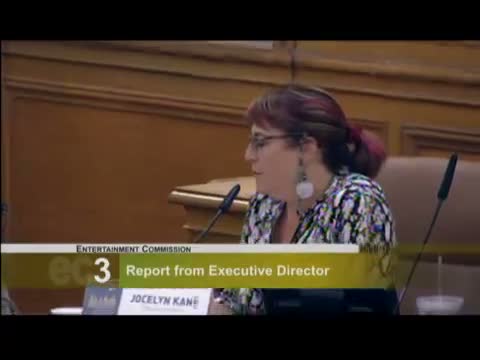
Director Kane told commissioners staff is drafting "a new permit that doesn't exist, related to fixed place amplified sound," and proposed scheduling a public hearing on Nov. 15 to gather input before introducing legislation to the board. Kane described the package as a "legacy piece of legislation" that will try to make sense of sections of the code that staff and venue operators find confusing in practice.
The proposal would separate entertainment-related amplified sound from non-entertainment uses and clarify rules for venues that have both indoor and outdoor spaces and for bundled or multi-day permits. Kane said the city will conduct targeted outreach — especially around known conflict areas such as Union Square and the Powell Street turnaround — and coordinate closely with police because the changes will move provisions in the police code.
The commission was also asked to help implement a resolution introduced by Supervisor Scott Wiener urging creation of an LGBTQ Nightlife and Culture Working Group. The resolution asks the Mayor's Office of Economic and Workforce Development (OEWD) and the Entertainment Commission to convene the working group "to develop, promote, and expand programs to support LGBTQ nightlife and cultural heritage," and to deliver a strategy to the board within six months. Kane said the resolution frames the working group as "citywide," not confined to a single geography, and solicited commissioner help identifying representatives from daytime and nightlife cultural organizations.
Dylan Rice, the commission's new events analyst, described related work on public-event operations: collecting after-action reports from police districts and assembling data on when off-duty officers (10B assignments) are required. "These reports show number of officers hired, locations, number of arrests or citations, and then the dollar difference between the estimate that was given the producer and the actual expenses," Rice said; he said that data will be presented to the commission and the board by the end of the calendar year to inform future policy decisions.
Next steps: staff said it will prepare the draft changes, pursue outreach to impacted stakeholders and hold the public hearing targeted for Nov. 15. The Wiener resolution tasks OEWD and the commission with convening the LGBTQ working group and producing a strategy within six months.