Get Full Government Meeting Transcripts, Videos, & Alerts Forever!
Get email alerts on the Development Review Policy topic
No spam. Unsubscribe anytime.
Entertainment Commission delays vote on rules to trigger hearings for new housing near venues
Summary
The San Francisco Entertainment Commission reviewed a draft set of criteria — including venue capacity, proximity, complaint history and project size — to decide which new residential projects must go to a public hearing; commissioners voted to continue the item for more data and a planning‑department briefing.
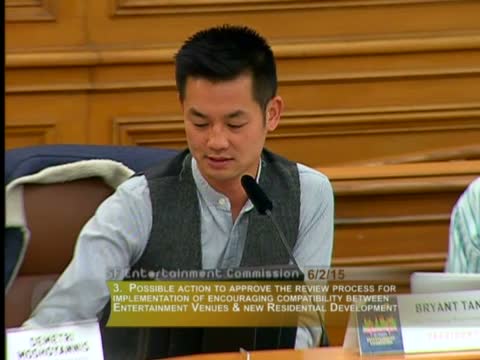
President Bridal Tan and staff presented a draft policy on June 2, 2015 proposing how the Entertainment Commission should be notified and when it should hold hearings on new residential development near places of entertainment. The draft would create a three‑commissioner development review committee, appointed annually and including the president (or vice president) and an urban‑planning representative, to hear projects that meet specified triggers.
The draft criteria discussed included: a capacity threshold (staff used 270 as an initial ‘‘average’’ drawn from the city’s list of places of entertainment), proximity (discussion centered on a 100‑ to 300‑foot radius), a complaint‑history trigger (several complaints over a 12‑month period), a size trigger tied to seven or more residential units (the same threshold that triggers an environmental review), and a venue history test (staff proposed 10 years; commissioners suggested 5 years or fewer).
Commissioners repeatedly pressed staff for more data before committing to numeric thresholds. ‘‘Let’s not make the triggers too easy so that we don’t have hearing after hearing after hearing all the time here,’’ President Tan said, arguing for predictability for project sponsors while protecting existing venues. Staff (Jocelyn) told the commission the legislation is new, that many pieces (including notification rules) lie outside tonight’s vote, and that staff discretion would be part of the process: items could go to the review committee or be handled administratively depending on circumstances.
Commissioners also asked technical and procedural questions: what paperwork and design documents should be included in the staff packet, whether exterior materials and egress would be reviewed, and how acoustical measurements required by the legislation would be performed. Staff said the commission will receive a planning‑department briefing before the next meeting and that the legislation itself requires sound measurements; in many cases the project sponsor would arrange and pay for acoustical testing.
Public comment urged broader latitude for the commission and for mandatory, rather than merely encouraged, outreach between developers and venue operators. After public comment, the commission voted to continue the item to the next meeting so it could review planning‑department material and specific data about how the numeric triggers would map onto existing San Francisco venues.
The commission’s decision to delay means staff will return with additional information — including the results of the Planning Department briefing — before members adopt a final set of triggers or committee rules.