Get Full Government Meeting Transcripts, Videos, & Alerts Forever!
Get email alerts on the Transportation topic
No spam. Unsubscribe anytime.
City report outlines gaps in late‑night transit, urges bus network refresh and agency white papers
Summary
A working group report presented to the San Francisco Entertainment Commission found roughly 250,000 weeknight late‑night trips, strong public interest in all‑night BART and incremental bus and Muni service improvements, and recommended near‑term service planning plus agency white papers on later rail operations.
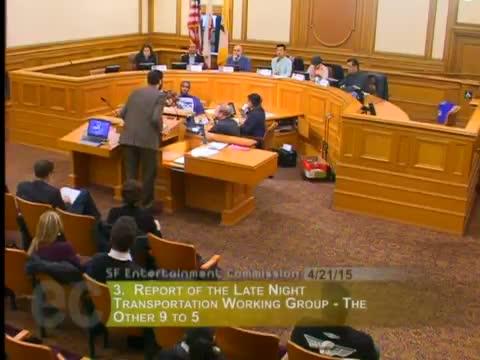
Liz Bryson, senior transportation planner at the San Francisco County Transportation Authority (SFCTA), told the Entertainment Commission the Late Night Transportation Working Group’s report found significant late‑night travel demand and several service gaps that affect workers as well as nightlife patrons. "About 250,000 people on a weeknight," Bryson said of late‑night trips, "that's about 7% of total daily trips." The study drew more than 2,800 survey responses and distilled needs into five categories: availability and coverage; speed and reliability; traffic safety and personal security; information and comfort; and cost and equity.
The report, NightlifeSF.org and an accompanying fact sheet, recommends immediate steps and longer‑term goals. Ben Van Houten of the Office of Economic and Workforce Development, a convenor of the working group, described the effort as "a first milestone step for us, but it's not the end of our work." Bryson highlighted near‑term items including refreshing the regional 'all‑nighter' bus network funded originally by a 2004 bridge‑toll program and coordinating incremental Muni late‑night Owl expansions already supported by Lifeline funding.
Commissioners pressed for operational detail. Commissioner Joseph asked why rail systems must close nightly; Bryson explained rail systems require a maintenance window and that much of the overnight downtime goes to system shutdown and logistical movements, not only to hands‑on maintenance. Bryson said the working group is recommending each rail operator — BART, Muni and Caltrain — produce white papers documenting constraints and capital needs to assess later operating hours. "We're asking each of the transit operators to develop a white paper to further document the constraints," she said.
The presentation cited a number of service improvements already underway: Muni Owl additions and frequency improvements, a weekend AC Transit/BART Transbay supplement, and early implementation by BART and AC Transit of overnight Transbay options. Bryson also noted a separate regional study — led by the Metropolitan Transportation Commission with partners including SFMTA, AC Transit, BART and Caltrain — has funding (about $2,000,000) to study Transbay corridor capacity that could influence future late‑night rail planning.
Why it matters: commissioners and presenters repeatedly framed late‑night transit as a worker‑and‑equity issue as much as a nightlife concern — bakers, janitors, hospitality workers and hospital staff rely on transit at nonstandard hours. The working group proposes data‑driven service planning and targeted corridor audits to improve safety, signage and information in nightlife districts while pursuing longer‑term capacity improvements.
Next steps: the working group plans to convene transit operators for white papers, pursue detailed service planning for regional late‑night buses, and continue stakeholder engagement. The report and data (including the full survey) are available at NightlifeSF.org.