Get Full Government Meeting Transcripts, Videos, & Alerts Forever!
Get email alerts on the Venue Protection topic
No spam. Unsubscribe anytime.
Entertainment Commission backs legislation to protect long-standing music venues from new nearby housing
Summary
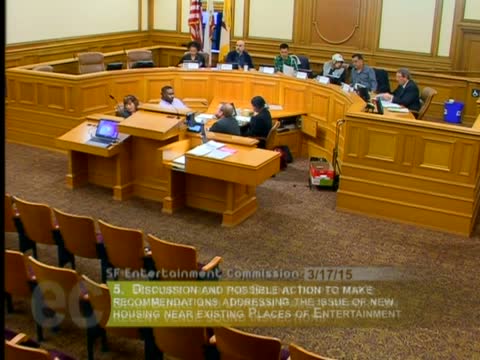
The commission voted unanimously March 17 to support legislation that would notify the commission and developers when new residential projects are proposed within 300 feet of an existing place of entertainment and require disclosure to prospective residents. The measure also clarifies that venues operating within their permits cannot be deemed legal nuisances.
SAN FRANCISCO — The San Francisco Entertainment Commission voted unanimously March 17 to formally support legislation aimed at reducing conflicts between long-standing music venues and new nearby residential development.
The measure, presented by Connor Johnston, legislative aide to Board President London (as introduced in the meeting record), would require planning staff to notify the Entertainment Commission and developers when a residential project is proposed within 300 feet of a mapped place of entertainment (POE). The Commission would be able to hold a hearing and offer recommendations to planning and the Department of Building Inspection on how the venue and proposed housing could coexist. Johnston said the city’s map currently includes about 350 POEs.
"If a POE is operating within the terms of its permit, the terms that the city has asked it to comply with, that it cannot be deemed a legal nuisance," Johnston told commissioners, adding that the bill also requires disclosure to prospective tenants or buyers when a residence sits within 300 feet of a POE.
The proposal includes a notice on title or other required disclosure mechanism and a civil penalty for failure to comply. Johnston said the legislation uses the Planning Pre-Application (PPA) stage so the Entertainment Commission can weigh in early without lengthening the standard permit timeline.
Commissioners asked about specific enforcement mechanics — including whether disclosure obligations extend to future lessees and what triggers enforcement. Johnston responded that the revised administrative code language (referenced in the presentation as admin code sections 116.8 and 116.9) lays out tenant and purchaser obligations and allows the POE to request an affidavit showing that disclosure was provided; the city can pursue action if it was not. Training and coordination with planning and DBI would determine how recommendations are implemented.
Supporters and industry groups were cited during the presentation: the California Music and Culture Association, the Department of Building Inspection’s code advisory committee and the Small Business Commission (the latter two noted as having endorsed the legislation). Johnston also cited controller numbers presented as context for nightlife’s impact, saying venues draw millions of customers and hundreds of millions of dollars in annual spending.
After public comment backing the bill, Commission member Joseph made a motion that the Entertainment Commission support the legislation and recommend it move through land use and the full board. The motion passed unanimously, with recorded aye votes from Commissioners Frost, Lee, Joseph, Moscianis, Cavanaugh and President Tan.
Next steps: commissioners voted to endorse sending recommendations to Planning and DBI; the presenter said the item would be scheduled with the Building Inspection Commission and Planning Commission and then move to the Board’s land use committee and full board if those steps are successful.
The commission’s formal support does not change code by itself; it is an advisory action that advances the legislation through the city process.