Get Full Government Meeting Transcripts, Videos, & Alerts Forever!
Get email alerts on the Land Use topic
No spam. Unsubscribe anytime.
Entertainment Commission revisits limited-live permits in Western SoMa zoning debate
Summary
Commissioners and planning staff reviewed how the Western SoMa plan treats limited live performance (LLP) permits, heard from Supervisor Kim’s office about demand in commercial corridors, and discussed whether rezoning or code amendments are needed to expand LLPs beyond the current north/south Harrison Street boundary.
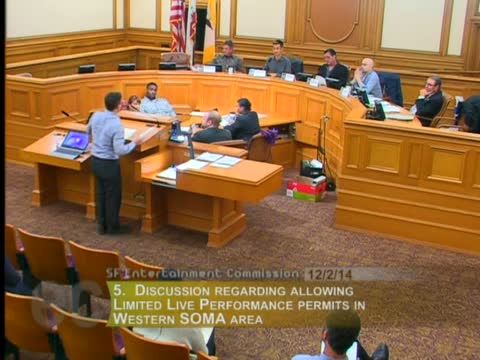
The Entertainment Commission on Dec. 2 heard a presentation from the Planning Department and Supervisor Jane Kim’s office on how limited live performance permits fit into the Western SoMa plan and city zoning.
Corey Teague of the Planning Department said the Western SoMa plan treats entertainment uses differently north and south of Harrison Street: nighttime entertainment is generally allowed south of Harrison in office (WMUO) and arts/production districts (SALI), and LLPs are permitted on established commercial corridors such as parts of Folsom and Eleventh Street, but LLPs were excluded from residential enclave and some mixed-use-general (WMUG) districts north of Harrison. Teague said the plan also established 200-foot buffers to shield residential enclaves from nighttime entertainment; those buffers apply to nighttime-entertainment uses but not to LLPs, meaning an LLP may be permitted where the underlying zoning allows it.
April Veneracion from Supervisor Kim’s office said the supervisor’s staff supports reexamining where LLPs may be appropriate in Western SoMa and asked the commission to develop recommendations that include outreach to neighbors and businesses. Veneracion noted two formal LLP applications in the area and interest from other businesses that may not apply if LLPs are unavailable.
Commissioners discussed whether Harrison Street remains an appropriate dividing line and whether selective code amendments or rezoning would be required to expand LLPs. Planning staff said changes would require a legislative process—sponsorship by a supervisor, the mayor, or a department, a Planning Commission review and, in many cases, environmental review—and could be packaged with other code amendments. Several commissioners urged focusing on targeted, practical remedies (for example, allowing LLPs in specific neighborhood-commercial corridors) rather than wholesale rezoning.
Why it matters: LLPs are designed to let existing small businesses add limited amplified performance or movies without becoming full nightclubs. Restricting LLPs to some corridors but not others can affect small businesses’ ability to add modest live programming and shape neighborhood character as Western SoMa continues to change.
What’s next: The commission invited planning staff and Supervisor Kim’s office to supply application and complaint data for LLPs in Western SoMa to inform future recommendations and asked commissioners to develop specific questions or outlines for regular SFPD district updates that could feed into any policy proposals.