Get Full Government Meeting Transcripts, Videos, & Alerts Forever!
Get email alerts on the Limited Live Performance Permit topic
No spam. Unsubscribe anytime.
San Francisco workshop walks small-business owners through Limited Live Performance permit
Summary
City officials and venue operators at an Entertainment Commission workshop explained how the Limited Live Performance (LLP) permit works, covering equipment costs, booking and pay arrangements, promotion strategies and permit rules including a 200-square-foot limit, 10 p.m. cutoff and fees.
San Francisco’s Entertainment Commission on a city-hosted workshop laid out practical steps for cafes, restaurants and other small businesses seeking to add live music under the city’s Limited Live Performance (LLP) permit.
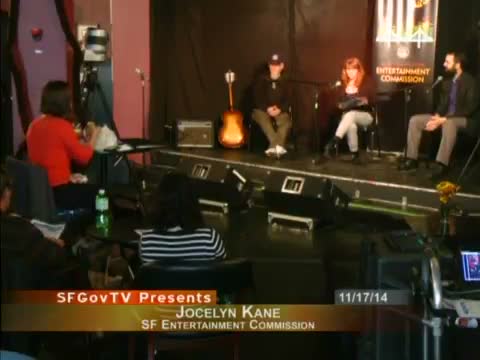
“This is our first time doing this, workshop ‘Just Add Music,’” said Jocelyn Kane, director of the Entertainment Commission, opening the session and explaining the commission’s role in issuing the LLP permit. Ben Van Houten of the Office of Economic and Workforce Development said the permit “presents a lot of really interesting opportunities for people to be creative in their businesses, to to bring in a variety of entertainment.”
The session combined regulator guidance with on-the-ground venue experience. Cammie Blackstone, the commission’s permanent administrator, summarized permit limits and the approval process: “The space where the entertainment occurs cannot take up more than 200 square feet,” she said, and live performance must end by 10 p.m.; after one year without complaints a venue may request an administrative one‑hour extension to 11 p.m. Blackstone also listed fees: a $416 application and $165 annual renewal.
Venue operators and musicians described practical logistics. A partner from 50 Mason Social House said small venues use house PA equipment and a ‘back line’ of instruments to simplify changeovers and attract performers, and gave cost examples: short-term PA rental around $150; a used mixer-amp $100–$300; and a basic new mixer and speakers roughly $1,000–$1,200. The Shure SM58 microphone was cited as a common, roughly $80 retail example.
Speakers discussed booking and compensation models. Speakers recommended starting with one reliable act and building out a schedule, using confirmation forms to document arrival times, load-in logistics and expectations, and relying on artists’ social networks and platforms (Craigslist, Indie on the Move, ReverbNation) to find talent. On pay, operators described mixed approaches—some earlier no-cover nights paid bands from a percentage of sales, while busier nights use cover charges and split proceeds; one example percentage named in the workshop was 15% during the performance period. Tip buckets were also described as a longstanding source of supplemental income for performers.
Panelists emphasized promotion and partnerships: consistent calendars, social media posts and themed recurring nights help audiences know what to expect. Promoters or business districts can coordinate multi-venue events; an Ocean Avenue CBD plan was described in which 5–8 venues would apply for LLP permits and host concurrent music to create a block‑level stroll.
Commission staff said the permit is intended to be accessible and relatively low-cost, with about 63 active LLP permit holders and only a few that have requested the one‑hour extension. The commission encouraged prospective applicants to contact its office for guidance and flagged NightlifeSF.org as a resource with contact information and a copy of the LLP flyer.
No formal votes or regulatory changes occurred at the workshop; staff framed the event as outreach and technical assistance for prospective applicants. The commission offered to provide application materials and staff support to help venues follow permit requirements and community outreach steps.
The commission said it would continue outreach and that applicants may call the Entertainment Commission or visit NightlifeSF.org for details on how to apply or prepare their venue.