Get Full Government Meeting Transcripts, Videos, & Alerts Forever!
Get email alerts on the Noise Nuisance Permit topic
No spam. Unsubscribe anytime.
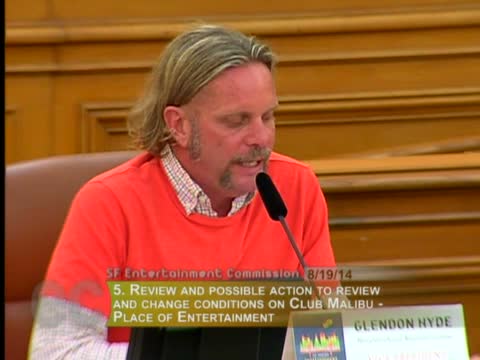
Entertainment Commission reconditions Club Malibu permit, imposes limits on live entertainment and bass frequency
Summary
After repeated neighborhood complaints about low-frequency bass and noise, the Entertainment Commission reconditioned Club Malibu’s permit with limits on hours, a security ratio, bass mitigations and a prohibition on outdoor music; commissioners approved the new conditions in a unanimous vote.
The San Francisco Entertainment Commission voted unanimously to recondition Club Malibu’s place-of-entertainment permit at 3395 Mission Street, imposing time limits on music, requirements for added security, and technical measures to stop low-frequency bass from escaping the building.
Commissioners said they acted after multiple neighborhood complaints and police records documenting noise and nuisance calls. Staff and police evidence presented to the commission showed repeated noise complaints tied to bass frequencies that penetrate neighboring homes and cause persistent disturbance.
Under the conditions the commission adopted, entertainment hours will be limited until the venue achieves sufficient soundproofing: entertainment curtailed to 11:30 p.m. Sunday–Thursday (holidays included) and 12:30 a.m. Fridays and Saturdays; live music is restricted to weekends and holidays. The permit must also include an enforced security staffing ratio (one security guard per 75 patrons) and a posted outdoor security presence during entertainment hours. The commission required additional sound-mitigation work (baffles for roof vents and skylights) and a limiter or equalization that significantly reduces low-frequency output; staff described this as removing bass frequencies below the agreed threshold to prevent vibration transmission into residences. The venue must provide monthly entertainment calendars to the SFPD, the commission and neighbors; third-party promoters were prohibited under the new conditions.
Commissioner Joseph, who pressed the club on long-standing complaints, told the owners: “This is about the noise. You have a noise problem, not a bigotry problem,” emphasizing that technical mitigation and operational changes were required. Club advocate Raquel warned commissioners that a strict midnight curfew would threaten the club’s business model, saying, “If that were the case, the club would not survive.”
Staff and inspectors recommended conditioning the permit "until adequate soundproofing had been achieved," and the commission agreed to review compliance and allow the club to request easing conditions if measurements and neighborhood reports show sustained improvement.
The roll call on the motion recorded all present commissioners voting aye; the motion carried and the new conditions take effect immediately. The commission directed staff to schedule follow-up inspections and to reopen the permit for amendment if problems persist.