Get Full Government Meeting Transcripts, Videos, & Alerts Forever!
Get email alerts on the Plaza Program topic
No spam. Unsubscribe anytime.
San Francisco staff outline Plaza Program to support local plaza stewardship and limited live performances
Summary
City staff proposed a new Plaza Program (Administrative Code Chapter 94) to support community stewards for public plazas, streamline event permitting, and add limited live-performance rules to the police code; officials said stewards would reinvest any plaza revenue into maintenance and programming.
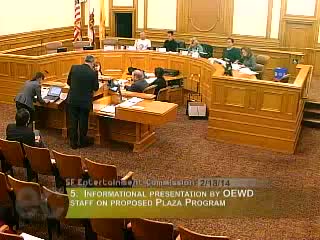
Ken Rich of the Office of Economic and Workforce Development presented a proposal to the San Francisco Entertainment Commission to establish a formal Plaza Program and companion code changes that would make plazas eligible for a limited live-performance framework.
The plan would create Administrative Code Chapter 94 to define program structure, add supporting amendments to the planning and public-works codes, and change the police code to treat certain plazas as "limited live-performance locales." Rich said the program is intended to "activate local plazas and public spaces and enhance their public realms," and that participating plazas would be stewarded by community groups selected through an open procurement process.
Robin Havens, who led a longer explanation of the proposal, said the program targets plazas generally larger than 2,000 square feet that emerge outside Recreation & Park jurisdiction (for example, pavement-to-parks sites or spaces created through area plans). Havens said stewards would submit annual applications and a comprehensive event plan; "all the revenues from those go back into the programming and maintenance of that specific plaza," she said, describing the model as relying on a mix of event-generated revenues and streamlined municipal support.
The presentation laid out two plaza types: street plazas (remaining in the right of way) and city plazas (spaces no longer designated as streets), and described criteria stewards must meet on programming, maintenance and community outreach. Staff also noted the proposal includes permitting changes to reduce per-event costs and give a steward a single permit holder role for sound in the space, relying on police-code sections used to manage amplified-sound compliance and enforcement.
Commissioners asked how stewards would pay for ongoing cleaning and programming when events were free; Havens said revenue is one avenue but acknowledged some activities would not generate fees and said the LLP permit and steward model would lower per-event costs and create an administrative path to absorb low- or no-revenue programming. The presenters said the legislative package must be approved by the Board of Supervisors and that plazas would be added plaza-by-plaza after the ordinance is adopted.
Why it matters: the proposal attempts to create a citywide framework so community groups can run recurring arts, markets and music programs in publicly accessible plazas without repeating complex permit steps for each event. Staff said they expect to propose two or three pilot plazas when the program is ready.
Next steps: OEWD staff said the legislative package will move forward to the Board of Supervisors for consideration and that plaza nominations would follow once the ordinance is enacted.