Get Full Government Meeting Transcripts, Videos, & Alerts Forever!
Get email alerts on the Permits topic
No spam. Unsubscribe anytime.
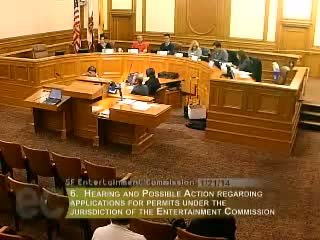
Entertainment Commission delays decision on 4234 Mission Street permit after residents cite noise, loitering and public‑safety concerns
Summary
The commission continued Jose Escolero’s application to operate live entertainment at 4234 Mission Street (doing business as La Officina) to Feb. 4 after neighbors described loud music, loitering, urination and vomiting; Ingleside Station presented statistics showing a drop in nearby crime and recommended 15 permit conditions.
The San Francisco Entertainment Commission voted to continue consideration of a live‑entertainment permit for 4234 Mission Street to its Feb. 4 meeting after neighbors pressed the commission for more outreach and enforceable conditions. Applicant Jose Escolero, doing business as La Officina, has operated the location about four months and said he wants to continue hosting live music.
Deputy Director Cammie Blackstone introduced the application and noted neighborhood concerns and recommendations from Ingleside Station; she told the commission staff had the venue’s ABC paperwork and would pull prior permit conditions for commissioners to review. Blanca, who spoke for the applicant, said Escolero is “the new owner for 4234 Mission Street” and that the venue had live music on Fridays and Saturdays. She said security pat‑downs and bag checks are performed and that staff tries to keep noise down and call rides for intoxicated patrons.
Neighbors and property owners urged caution. Patricia Cavanaro, whose family owns two buildings adjacent to the venue, said tenants have “young children” and described past incidents of fighting, urination and vomiting outside the building. She told commissioners, “We spent more than $2,000 putting lights strategically to stop this happening.” Laurie Heath and Dan Heath presented time‑stamped photos and described vomit and urination on sidewalks and driveway entrances; Dan Heath said he was awakened at 1:30 a.m. on a recent night when live music was playing. Joelle Keneally, president of the Outer Mission Merchants and Residents Association, said the applicant had not completed community outreach and urged the commission to require it.
Ingleside Station Permit Officer Sgt. Eli Turner told the commission the station conducted a statistical assessment comparing the venue’s three‑month run under the current temporary permit (Sept. 24–Dec. 24, 2013) with the prior establishment. Turner said crimes plausibly related to alcohol within a 500‑foot radius fell by “approximately 20%,” and by “approximately 40%” within a 250‑foot stretch along Mission Street. Nevertheless, Turner said mandatory, enforceable permit stipulations remain essential and the station supported adding the 15 recommended conditions, which mirror the commission’s safety and security best practices pamphlet.
Commissioners questioned whether the venue had been operating without the commission’s final permit, discussed temporary‑permit timelines and whether duplicative language should be struck where police conditions repeat items already included in the commission’s Good Neighbor Policy. Staff said the Good Neighbor Policy is attached to permits and has recently been translated into Spanish; commissioners pressed the applicant to meet with neighbors and demonstrate concrete steps to address language barriers and outside‑patron behavior.
After discussion about the commission’s 45‑day administrative window (after which a permit may be issued under state timelines) and the value of immediate outreach, a motion to continue the item for two weeks (to the Feb. 4 meeting) passed on a voice vote with commissioners recording Ayes. The commission also reiterated that the applicant may not host live entertainment while the permit matter remains unresolved.
Next steps: staff will provide prior permit conditions and facilitate meetings between the applicant and neighborhood representatives before the Feb. 4 hearing. The commission recorded the continuance to allow mediation and to consider specific, enforceable conditions.