Get Full Government Meeting Transcripts, Videos, & Alerts Forever!
Get email alerts on the Event Policing 10b topic
No spam. Unsubscribe anytime.
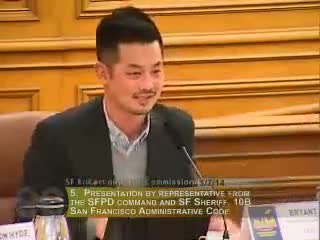
Commission hears 10B explanation and sheriff urges partnership to lower event policing costs
Summary
SFPD presented how the city staffs and bills for additional police services under Charter Section 10B; Sheriff Ross Mercarimi urged using deputies and interagency coordination to reduce costs for small promoters while commissioners pressed for clearer timelines and itemized estimates.
Sergeant Galeno of the San Francisco Police Department outlined how the city's 10B program handles requests for additional event policing, saying the code allows "any person, corporation, firm, or organization" to request extra officers and related services. The 10B office centralizes staffing and coordinates with ISSCOT permitting, the district station and other agencies to produce an operational plan and a cost estimate for organizers.
Galeno said the office provides staffing estimates based on event size, prior history and whether alcohol will be served, and that organizers receive a written estimate and pay a deposit before officers are scheduled. "Once it's signed off, the organizers come to us with their needs," he said, explaining that final costs are reconciled post-event because actual hours can differ from projections.
Sheriff Ross Mercarimi told commissioners his department is interested in a greater partnership with SFPD to reduce costs for promoters and taxpayers. "The Charter 10B is very clear in its stipulation that it provides the San Francisco Police Department as the agency that has the first right of refusal," Mercarimi said, but he added sheriffs can be an alternative resource and estimated a roughly 23 percent pay differential that can lower overtime costs when deputies participate.
Commissioners asked how staffing numbers are decided, whether itemized bills are provided and how disputes between promoters and 10B are resolved. Galeno said staffing levels result from interagency ISSCOT meetings among police, parking/traffic, DPW and other stakeholders; the transportation code contains permit timelines and pay scales for certain "grandfathered" events. He said centralization in 2012 aimed to improve coordination across large city events.
Event producers and neighborhood organizers who spoke during public comment said the system has improved in places but remains unpredictable for smaller nonprofits and community organizers. United Player's director said her group was once told it could not hold a small indoor anniversary because of a last-minute 10B requirement; she said the cost was prohibitive. Dawn Holiday, who produces Hardly Strictly Bluegrass, said large multi-day events do receive reliable service and district officers who know the event's needs.
Commissioners urged staff to publish clearer timelines and make estimates available earlier so nonprofits and small promoters can budget. The commission did not take a formal vote but requested further follow-up and scheduled 10B as a possible future agenda item.
The commission heard specifics on how attendance tiers (roughly 0—100,000; 100,000—250,000; more than 250,000) affect pricing and that staffing is voluntary for officers, who can call out for illness or emergency; organizers are informed when staffing cannot be met. The office provides written estimates and reconciles final charges after payroll. The sheriff and police committed to continuing dialogue about whether more flexible, lower-cost sheriff staffing or other reforms could help smaller event organizers.