Get Full Government Meeting Transcripts, Videos, & Alerts Forever!
Get email alerts on the Nightlife Regulation topic
No spam. Unsubscribe anytime.
Entertainment Commission discusses party-bus outreach, late-night transit pilot and new venue sound systems
Summary
The commission’s executive director reported on outreach to party-bus operators, data on towing after a change from 8 p.m. to 10 p.m., nascent conversations with BART about a 3 a.m. bus pilot and staff encouragement for AT&T Park to use surround-sound speaker setups that may reduce neighborhood noise.
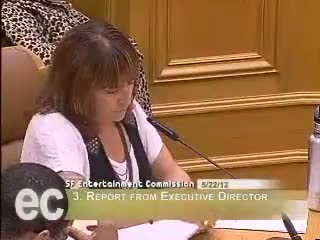
The San Francisco Entertainment Commission heard an update May 22 from Executive Director Kane on several operational issues affecting nightlife and venues across the city.
Kane said staff will convene party-bus operators, venue representatives and local elected officials in June to explore ways to reduce incidents in which highly intoxicated patrons are dropped on city streets. "We continue discussions on party buses," Kane said, describing the goal as finding ways to “assist in their operation” and to discourage a business model that drops intoxicated patrons on sidewalks. Kane cited a failed Assemblymember Hill bill from the prior year as background for the outreach efforts and said she planned to invite Supervisor David Chu and other interested officials to the meeting.
Kane told the commission that Central Station towing data for April 6–May 12 showed 109 tows after the towing policy on Broadway changed from 8 p.m. to 10 p.m. She said staff will analyze whether vehicle types or other factors changed and whether the later towing time affected the tow count: "That month from April 6 to May 12, there was 109 tows," Kane said, adding she would look for more data to interpret whether the change in enforcement hours altered outcomes.
Kane also described contact with BART about a proposal to run buses along BART corridors until 3 a.m., noting the possibility of a one-year, grant-funded pilot. "They were very interested in hearing more from this industry about how many people, in particular, the working people," Kane said, noting questions about how night-shift employees in the industry would use late-night transit.
Licensing staff reported on the Roger Waters concert at AT&T Park, saying the event produced relatively few complaints and that the production used a newer surround-sound speaker configuration intended to improve clarity while lowering overall volume. "We would like to see a few more concerts using this technology before we talk to them about making it an only surround sound style venue," a staff member said. Staff and commissioners discussed technical trade-offs, including higher initial costs for short-throw and digital relay systems and possible long-term neighborhood benefits when used at outdoor or back-patio spaces.
The executive director and staff flagged other enforcement matters that remain under review: ongoing sound complaints at a brick-and-mortar venue where staff set a June 26 deadline for new soundproofing; continuing follow-up at Abbey Tavern in Richmond after a disorderly graduation-party crowd required significant crowd-control response; and monitoring compliance at a venue identified in the transcript as La Officina.
Kane closed by saying she had no corrective actions to report at this meeting and will keep the commission apprised as staff convene stakeholders and gather additional data.
What happens next: staff will return with follow-up analyses on towing data and any outcomes from the scheduled June convening with party-bus operators and community representatives.