Get Full Government Meeting Transcripts, Videos, & Alerts Forever!
Get email alerts on the Permits And Enforcement topic
No spam. Unsubscribe anytime.
Commission approves 12‑table Billiards Academy at 401 Broadway, strikes indoor‑camera and on‑demand video‑turnover conditions
Summary
After debate about privacy and police access to surveillance footage, the Entertainment Commission approved a place‑of‑entertainment permit for a 12‑table Billiards Academy at 401 Broadway, accepting police safety conditions but removing a requirement for indoor cameras and immediate on‑demand turnover to police and increasing minimum video retention to 30 days.
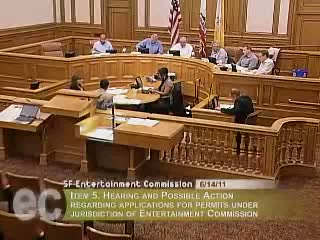
The Entertainment Commission on June 14 approved a place‑of‑entertainment permit for a proposed 12‑table Billiards Academy at 401 Broadway, subject to police and planning conditions but with two changes the commission adopted after debate: the commission struck a requirement that cameras be located inside the venue and removed language requiring immediate on‑demand turnover of recorded video to police. Commissioners also agreed to increase minimum video retention from 15 to 30 days.
Marsha Garland, who represented the applicants, described the project as an academy affiliated with the Billiards Congress of America and said the owners "own the building at 401 Broadway" and had consulted extensively with neighbors and merchant groups. Garland said applicants accepted most police and planning conditions and would post notices for security and camera policies if required.
Commissioners questioned several items in the police conditions, including why security was set to start at 9:30 p.m., how many cameras constituted a "set," and whether interior cameras would be required to capture activity inside the venue. One commissioner argued, "I don't mind cameras outside because walking on the street, we don't have an expectation of privacy," but expressed privacy concerns about indoor surveillance without clear city‑attorney guidance.
A different commissioner noted that "the city attorney did express reservations" about language turning over interior footage to police on demand and recommended that police obtain recordings through normal due process (warrants or subpoenas) rather than obligating permit conditions until the city attorney provides guidance.
A motion to approve the 401 Broadway permit with police conditions but striking the indoor camera requirement, removing the immediate turn‑over clause for police, and extending minimum retention from 15 to 30 days was moved and seconded and the commission concluded the item with the amended conditions. The application package shows planning’s conditions focused mainly on soundproofing and keeping noise inside the building; the applicants said they had been in touch with neighborhood organizations including the North Beach Merchants Association and Broadway Entertainment and Cultural Association.
The commission did not record an individual roll‑call vote for the final motion in the transcript; staff confirmed the motion carried and the permit will proceed with the amended conditions.