Get Full Government Meeting Transcripts, Videos, & Alerts Forever!
Get email alerts on the Enforcement And Public Safety topic
No spam. Unsubscribe anytime.
Entertainment Commission, SFPD clarify liquor-license vs. entertainment-permit rules; staff flags repeat citations and recent Clift Hotel incident
Summary
SFPD and Commission staff explained that ABC liquor licenses differ from city entertainment permits — licenses are state-regulated, sometimes treated as transferable assets, while city entertainment permits expire when a business closes. Staff also reported repeat noise citations at 600 Polk and a Clift Hotel incident with no injuries.
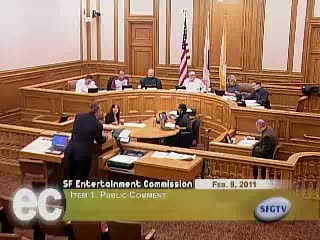
At its Feb. 8 meeting, the San Francisco Entertainment Commission and an SFPD inspector outlined the distinctions between state liquor licenses and city entertainment permits, described enforcement trends and flagged a recent security incident at the Clift Hotel.
An attendee at public comment asked whether permits and licenses are transferable property or privileges when a business is sold. Inspector Dave Falzon (SFPD) responded that the law draws a clear distinction: certain ABC (State Department of Alcoholic Beverage Control) licenses can be owned and transferred and are treated like assets in some cases, while a city entertainment permit is not an asset and ceases to exist when the business closes. Falzon said ABC maintains exclusive authority over state liquor licensing and local authorities can only offer recommendations to ABC when transfers are reviewed.
Staff and SFPD also reported enforcement trends affecting venues. Staff highlighted repeat citations at Noble’s/600 Polk: the venue passed sound tests only at a very low dBA limit written into its permit but has repeatedly exceeded that cap during operation, prompting ongoing citations and monitoring. Staff said they will continue citing noncompliance and may consider bringing venues back before the Commission if the behavior continues.
On safety, staff described an incident at the Clift Hotel lounge where a suspect allegedly carried a concealed firearm. Security intervened, SFPD responded, and security assisted with crowd control; staff said no one was injured and characterized the hotel-lounge configuration as presenting unique challenges for screening and lines, which will inform future outreach to similar venues.
Inspector Falzon also said SFPD will hold nightlife/club training this month and is evaluating the availability of off-duty (10B) officers for clubs, and described monthly permit-officer meetings created after the ALU unit was formed to improve coordination. He shared an industry email praising private ID-scanner use as a crime deterrent.
Why it matters: the discussion clarified legal responsibilities for license transfers and the limits of local authority, reaffirmed active enforcement at repeat-problem venues, and outlined SFPD training and coordination intended to reduce safety risks at nightlife events.
Next steps: staff will continue monitoring cited venues, coordinate with the city attorney on enforcement options (including responses to nonpayment of citations), and schedule joint training and hearings with SFPD and the Youth Commission as appropriate.