Get Full Government Meeting Transcripts, Videos, & Alerts Forever!
Get email alerts on the Nightlife Safety topic
No spam. Unsubscribe anytime.
SFPD and Entertainment Commission outline "nightlife initiative" with proposed mandated safety conditions for large venues
Summary
SFPD and the Entertainment Commission presented a joint "nightlife initiative" proposing mandated permit conditions — security supervision, vetted promoters, liaison officers and quarterly summits — aimed at reducing violence and improving coordination among clubs, police and residents.
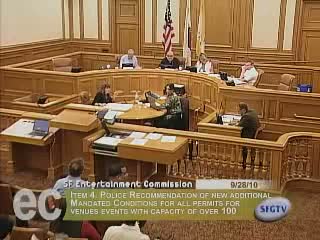
Commander Crenshaw of the San Francisco Police Department and Entertainment Commission staff presented a joint "nightlife initiative" on Sept. 28 that would add mandated safety conditions to permits for venues or events with expected occupancy over 100.
The initiative, described as a collaborative effort between the police, the Entertainment Commission and industry leaders, would focus on strengthening on‑site security supervision, requiring security plans reviewed by SFPD, and making operator permits and permits' supporting documentation available on request. Commander Crenshaw said the package grew out of recent summits and industry meetings and is intended to "come together and work with the EC and the industry to resolve a myriad of problems."
Inspector Fazlan (recorded in the hearing) gave an overview of the draft conditions, which the department framed as intentionally narrow to improve the chances of adoption. Key elements in the draft include requiring security supervisors in addition to guards, the possible use of ID scanners and metal detectors, directional exterior lighting, security personnel with appropriate guard licensing, a designated entertainment liaison at each police district, quarterly industry‑EC‑police meetings and a club communication line to improve on‑the‑ground coordination. The draft also recommends training for officers to better understand promoter/entertainment laws and a best‑practices appendix for operators.
Industry representatives who helped draft the materials — including representatives from SF Clubs and longtime venue operators — urged partnership and emphasized prevention. Ray Bobbitt of SF Clubs said the proposals reflected lessons learned from decades of operating venues and highlighted the industry’s interest in incident reporting and follow‑up: "We keep very good records, and you'll see as a part of these best practices, the incident reports and record keeping is a key part of our operation."
Commissioners agreed to form an ad hoc committee to review the material and work with all parties on a final document. President Newland (record in meeting) and Commissioner Joseph were named to continue work with SFPD and industry stakeholders.
The Commission did not adopt final rules at the meeting; staff and the ad hoc committee are expected to return with a refined proposal and an opportunity for broader public comment and edits. The initiative is procedural in scope: it lays out recommended permit conditions and tools for enforcement and oversight, while leaving final rulemaking and any required regulatory drafting for later meetings.