Get Full Government Meeting Transcripts, Videos, & Alerts Forever!
Get email alerts on the Entertainment Permit Suspension topic
No spam. Unsubscribe anytime.
San Francisco Entertainment Commission suspends Club Suede for 30 days after evidence of crowd-control failures
Summary
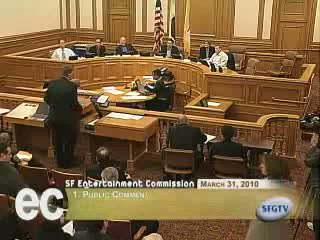
After testimony from police, inspectors and neighborhood businesses about repeated fights, overcrowding and security lapses, the Entertainment Commission voted unanimously March 31 to suspend Club Suede's place-of-entertainment permit (EC880) for 30 days, to begin April 5, 2010.
San FranciscoEntertainment Commission members voted unanimously March 31 to suspend Club Suede's place-of-entertainment permit (EC880) for 30 days after hearing testimony that the venue repeatedly failed to control crowds, comply with its security plan and prevent incidents that endangered patrons and the neighborhood.
The hearing followed a February shooting near the club in which "44 shots, 4 people injured, 1 person dead," Supervisor David Chiu said during public comment, urging the commission to act. Residents, hotel managers and business representatives described years of disturbances tied to the club; Kevin Carroll, executive director of the Fisherman's Wharf Community Benefit District, submitted a petition with more than 1,100 signatures asking for permanent revocation of the permit. "We feel that this club should have its its license revoked," Craig Schwann, general manager of the Sheraton Fisherman's Wharf, told commissioners during public comment.
City inspectors and San Francisco police officers detailed multiple incidents and prior notices to the club. Entertainment Commission inspector Vajra Granelli testified that Club Suede's place-of-entertainment permit lists an occupancy limit of 539 (255 on the first floor, 284 on the second), that the club did not hold an extended-hours permit and that an amended security plan dated January 2009 had not been followed. Granelli said a January inspection found patrons spilling onto the sidewalk and into a traffic lane, inconsistent counts of security staff, and a lost clicker count; on the night of the February shooting he described chaotic conditions with medics and officers attending to victims near the club's front door.
Commander James Dudley and multiple SFPD officers testified they had repeatedly warned club management since 2008 about overcrowding, overservice and security measures, and that they had advised steps such as earlier alcohol cutoffs, more staff outside the venue, posting guards at exits and LEADS training. Sergeant Laura Knight and other officers described multiple nights when sidewalks and streets were blocked, fights occurred in the adjacent streets and SFPD had to call additional units to disperse crowds, sometimes taking 25—25 to 35 minutes to clear the area.
Charging-party counsel argued the testimony and documentary exhibits showed numerous violations of the municipal police code and the good-neighbor policy attached to the permit, and asked the commission to impose the maximum suspension allowed by code: 30 days. Respondent counsel said the club would not object to a 30-day suspension but declined to stipulate to factual findings the charging party sought, and cautioned about public pressure on the process.
Commissioners framed the case as one of ongoing nuisance and public-safety risk rather than solely the isolated homicide that prompted renewed scrutiny. After deliberation the commission found a preponderance of evidence that Club Suede violated conditions of its permit and provisions of the San Francisco Police Code cited in the hearing and imposed a 30-day suspension. The commission's motion was seconded and carried with the commissioners present voting in favor.
The commission records and arguments show the charging party asked that the suspension begin April 5, 2010, and the respondent indicated it would not object to that start date. The commission did not revoke the permit; it imposed a time-limited suspension and closed the public hearing.
The commissionsaid it would continue to monitor compliance and recommended that the Board of Supervisors and city agencies consider legislative or procedural changes to close enforcement gaps identified during the hearing.
What comes next: the suspension was ordered by the Entertainment Commission; if the club seeks to reopen, the commission and city enforcement agencies will monitor whether Club Suede implements documented security and operational changes and complies with permit conditions.