Get Full Government Meeting Transcripts, Videos, & Alerts Forever!
Get email alerts on the License Revocation topic
No spam. Unsubscribe anytime.
Supervisor Chu proposes police-code changes to let Entertainment Commission seek permanent permit revocations after public-safety incidents
Summary
Supervisor David Chu introduced legislation to amend Police Code sections 10.60.2 and 10.70.2 so the Entertainment Commission can pursue permanent revocation of entertainment permits for venues that pose serious public-safety risks or persistent public nuisances. The item was discussed amid calls from police and neighbors after a shooting outside El Rincon.
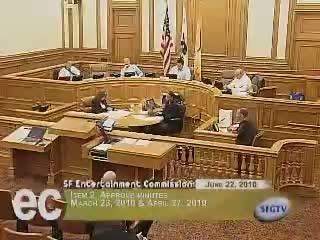
Supervisor David Chu on Tuesday asked the San Francisco Entertainment Commission to adopt language that would give the city stronger tools to close nightclubs that repeatedly endanger nearby residents.
Chu told commissioners he drafted changes to Police Code sections 10.60.2 and 10.70.2 to allow the commission to seek permanent revocation in two situations: when a venue’s operation poses a substantial risk of physical harm, and when a permittee’s persistent failures create a continuing public nuisance. “This legislation makes it easier for you to do your job,” Chu said, arguing that the change could reduce repeated short-term suspensions and the city-attorney hours currently required to pursue closures.
The proposal came as residents and law-enforcement groups urged immediate action after a shooting outside the El Rincon nightclub that injured a police officer. Gary Delantis, president of the San Francisco Police Officers Association, said the club has produced “numerous” complaints and at least nine recent calls for service tied to shootings, threats or weapons, and asked that the venue’s entertainment permit be revoked. Officer Gary Buckner of Mission Station told the commission staff had compiled a long file documenting alleged violations at El Rincon and recommended using emergency powers to suspend the venue beyond a 72-hour action already taken by staff.
Commissioners pressed Chu on two points: the cost of formal revocation proceedings (city-attorney time) and what evidence would be sufficient to justify revocation. Commissioner Amico warned that litigation costs could strain the commission’s budget; Chu replied that, in his view, granting revocation authority could ultimately lower costs by avoiding repeated, resource-intensive temporary suspensions. Commissioner Allen asked whether a record of police citations is required; Chu said the legislation allows the commission to consider a broader pattern of violence and noncompliance, relying on incident reports, security-plan failures and other documentation even when a citation has not issued.
The Department of Alcoholic Beverage Control and SFPD representatives said they are gathering reports and cooperating on possible administrative action. ABC District Administrator Justin Geb said ABC is collecting the file and will pursue administrative remedies if the evidence warrants. Inspector Dave Falzon described a continuing investigation and advised the commission that several statutory trigger points (assault and battery, discharging a firearm, unlawful weapons, disturbing the peace, violent felony enhancements) could justify a seven-day suspension under current rules.
Next steps: staff said it has issued a 72-hour emergency public-safety suspension for El Rincon and will agendize follow-up enforcement options, which could include a voluntary seven-day shutdown, a staff-initiated seven-day suspension, or eventual revocation if legal standards are met. Chu said he will continue to hold hearings at the Board of Supervisors to oversee implementation and transparency of complaint handling.