Get Full Government Meeting Transcripts, Videos, & Alerts Forever!
Get email alerts on the Waste Management topic
No spam. Unsubscribe anytime.
S.F. Environment Department urges new refuse-rate investments to meet 2030 zero-waste goals
Summary
Department staff told the Commission on the Environment that Recology must use its January 1 rate filing to fund reuse pilots, expanded contamination monitoring, safer battery collection and trash‑processing pilots that could recover roughly 40% of processed landfill‑bound material.
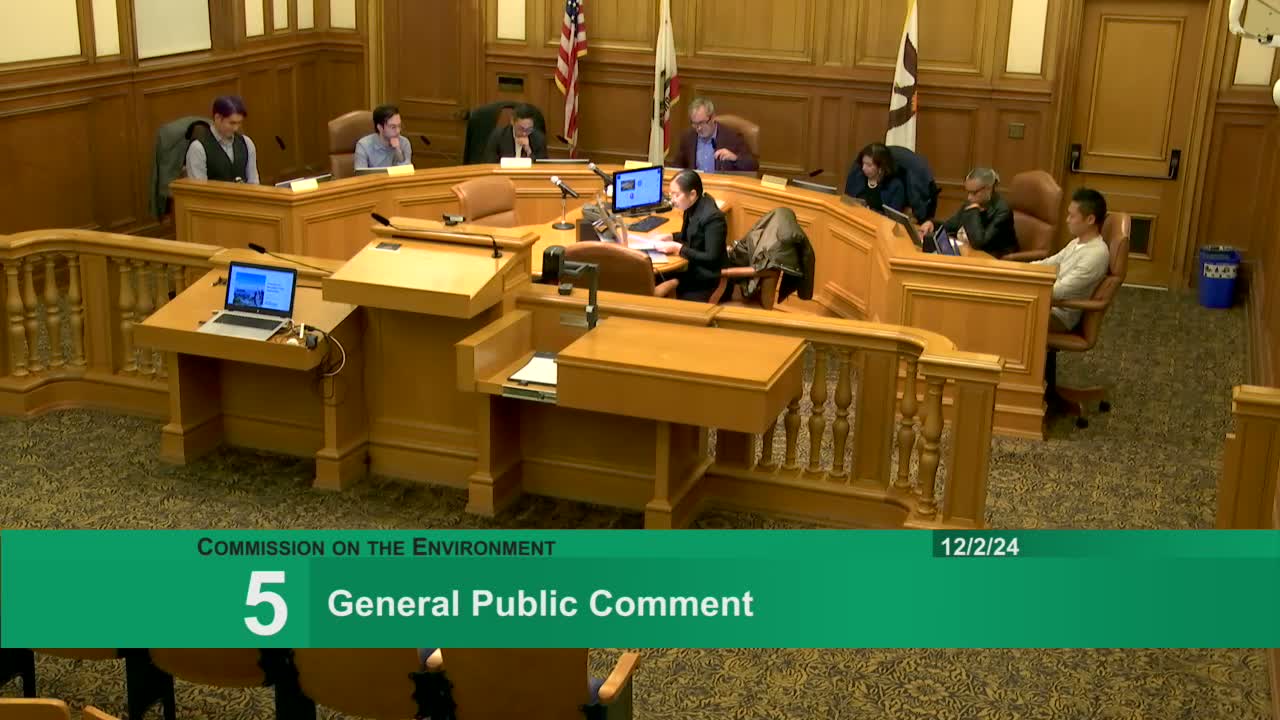
Alexa Kelty, Residential Zero Waste senior coordinator for the San Francisco Environment Department, told commissioners the city is entering a new refuse‑rate cycle and needs targeted investments through refuse rates to reach the city’s landfill‑reduction goals.
Kelty said the department expects Recology to submit its rate application on January 1 and recommended several program priorities for that filing, including expanding reuse in the bulky‑item pickup program, piloting dimensional‑lumber diversion, funding mattress drop‑off supported by the Mattress Recycling Council, increasing contamination monitoring and piloting alternative camera technology, and stepping up battery‑safety outreach for multi‑family buildings. “We’re about to enter a new refuse rate,” Kelty said in opening the presentation.
The presentation set a multi‑year scale of work: the city’s Chapter 9 target calls for a 50% reduction in landfilling from 2015 levels by 2030. Kelty said Recology touches roughly 70–80% of the material the city landfills; to meet the target Recology will need to recover or divert on the order of 168,000 to 210,000 tons—“and that has to happen in the next five years,” she said.
Kelty described results from pilots and studies to justify the investment. An HDR‑observed trash‑processing pilot suggested a recovery potential of about 39% from processed loads and possibly higher (approaching 45%) if organics‑rich commercial and multi‑family loads were targeted. The department is proposing Recology continue a pilot that would send up to 40,000 tons to a trash‑processing facility; staff estimate roughly 40% of that material could be recovered.
Kelty highlighted specific reuse opportunities identified in consultant ride‑alongs: about half of the material in the bulky‑item stream appears to have reuse potential through existing partnerships (for example, with St. Vincent de Paul). A two‑week pilot to collect dimensional lumber for local re‑use yielded over three tons, she said. She also noted the city currently lacks a free mattress drop‑off program and proposed expanding options subsidized by the Mattress Recycling Council to curb illegal dumping.
Staff emphasized regulatory drivers and safety: state law (SB 1383) now requires contamination monitoring and outreach for organics programs, and the department is rolling out expanded battery‑collection outreach after incidents in nearby jurisdictions underscored the fire risk from lithium‑ion batteries in recycling streams.
Kelty closed with recent program highlights paid for with ratepayer funds: a $400,000 waste‑characterization study now underway, 600 tons of building‑material reuse at Building Resources after a new operator and partnerships, 4,600 tons of donated food last full year, and 13 fix‑it clinics. Commissioners asked for more data on 311‑reported pickups versus scheduled bulky‑item requests; staff said they would follow up.
Next steps: staff said they will ask Recology to include these priorities in its rate application and to continue pilots, and they will present further details and data to the commission in upcoming meetings as the refuse‑rate process continues through mid‑2025.