Get Full Government Meeting Transcripts, Videos, & Alerts Forever!
Get email alerts on the Green Roofs topic
No spam. Unsubscribe anytime.
San Francisco's Better Roofs ordinance honored with national APA sustainability award
Summary
City planning and environment staff described the Better Roofs Ordinance's development and early results, and accepted an American Planning Association national award. Planning Department Director Jeff Joslin said the 2017 ordinance requiring solar and/or living roofs on qualifying projects has produced measurable planning tools and influenced other cities.
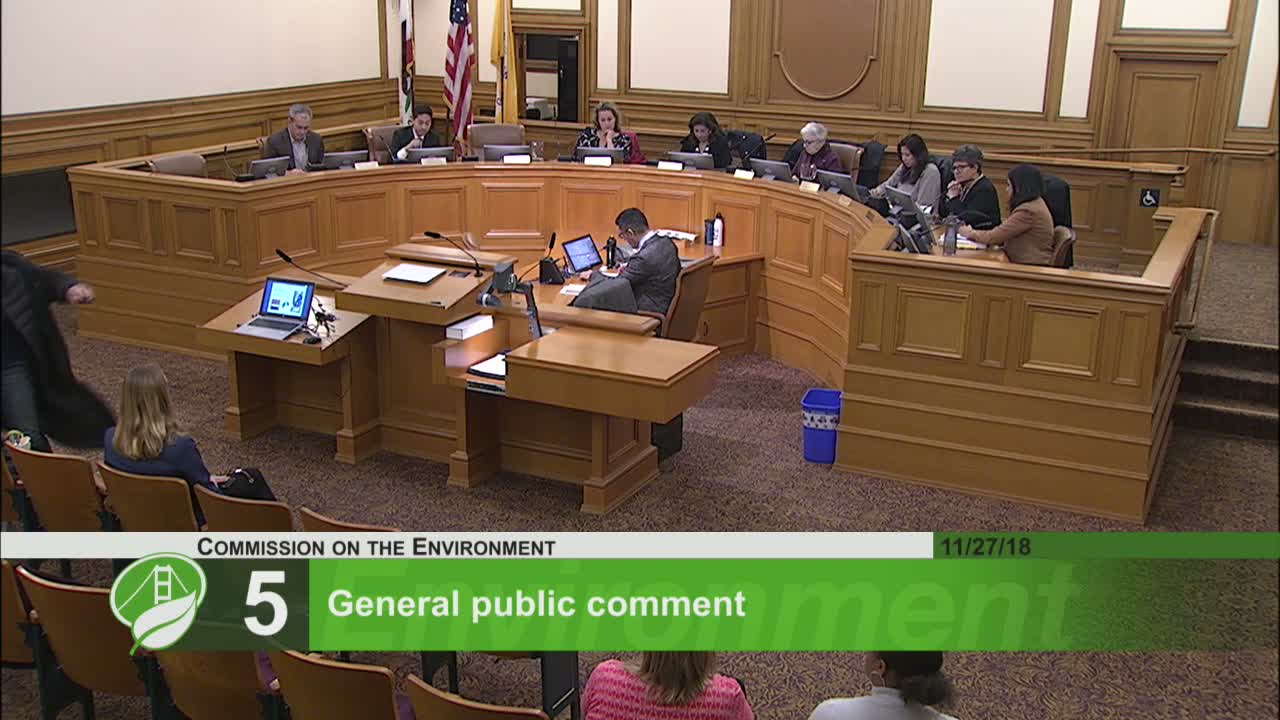
San Francisco officials on Tuesday celebrated national recognition for the Better Roofs Ordinance, a policy that requires solar panels and/or living (green) roofs on qualifying new development. The ordinance, which took effect Jan. 1, 2017, was presented with an American Planning Association national award for excellence in sustainability during the Commission on the Environment meeting.
Jeff Joslin, director of current planning for the San Francisco Planning Department, told commissioners the ordinance grew from a multi-agency and community effort that began with a cities-focused green-roofs conference in 2013 and subsequent technical and cost-benefit analysis. "When the ordinance took effect, we were fully implementation ready," Joslin said, adding that the policy has since been invoked as precedent by other jurisdictions pursuing similar requirements.
Joslin highlighted several anticipated benefits over a 15-year implementation horizon, saying the city expects a net economic and environmental gain. He cited projected additional tax revenue and meaningful reductions in carbon emissions resulting from widespread deployment of solar and living roofs. "This is the first such mandate in the country," Joslin said, and he described the ordinance as a model that has informed analyses and initiatives in Denver, Portland, New York and Vancouver.
Commissioners asked whether neighbors have legal avenues to object to rooftop installations on aesthetic or shading grounds. Joslin said San Francisco has not experienced such challenges and noted that zoning and planning-code height limits, rather than a separate "shade" ordinance, address building-scale shading concerns. "If shading was a potential issue for a solar component, living roofs would still succeed in that environment," he said.
Department Director Deborah Rafael thanked staff, the Planning Department and community stakeholders and accepted the award on behalf of the city. Commissioners paused for a quick photograph with presenters and award recipients.
Next steps: staff said they will continue monitoring implementation outcomes and share lessons learned with peer cities interested in similar measures.