Get Full Government Meeting Transcripts, Videos, & Alerts Forever!
Get email alerts on the Pesticide Policy topic
No spam. Unsubscribe anytime.
Commission adopts 2018 reduced‑risk pesticide list after public debate on stubborn invasive weeds
Summary
The San Francisco Commission on the Environment voted to adopt Resolution file 2018‑07‑COE approving the 2018 Reduced Risk Pesticide List, expanding notification and contractor‑training requirements and prohibiting herbicides on green roofs/walls; commissioners and public commenters praised large reductions in tier‑1 use while raising concerns about remaining applications for invasive species.
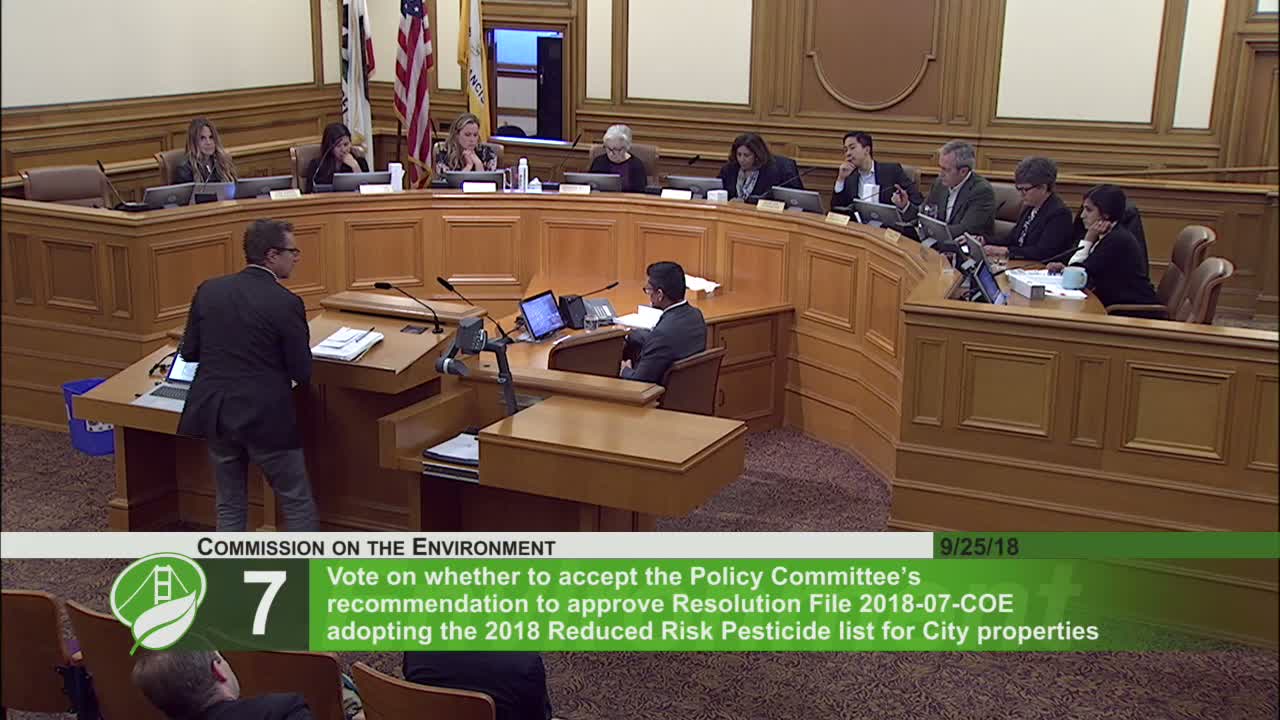
The San Francisco Commission on the Environment on Sept. 25 approved Resolution file 2018‑07‑COE, adopting the city’s 2018 Reduced Risk Pesticide List and new operating rules for pesticide use on city property. The motion, moved by Commissioner Walt and seconded by Commissioner Stevenson, passed by voice vote following staff presentations and public comment.
The department’s Integrated Pest Management program manager, Chris Geiger, told the commission that long‑term trends show large reductions in high‑hazard pesticide use. "From 2010 to 2017... it is a 96% reduction," Geiger said, and he described a 75% reduction since 2015 after glyphosate was reclassified by the International Agency for Research on Cancer. Geiger said staff have focused on training, interagency coordination and a public pesticide dashboard to track use.
Geiger outlined the specific changes the commission considered: extending public‑notice postings and blue indicator dyes to all herbicide treatments, tightening contractor training and supervision requirements, prohibiting herbicide use on green roofs and green walls, and clarifying language and exemptions in the product list. The update also adds boric‑acid ant baits as tier‑1 entries and continues limited exemptions for rat burrow treatments pending broader availability of a dry‑ice alternative.
Representatives from San Francisco Public Works and Recreation and Parks described operational challenges that drive limited use of tier‑1 products in a small number of cases. Karla Short of Public Works noted Bay Friendly training for gardeners and creative tactics — including a goat herd retainer for steep sites — to reduce chemical reliance. Lisa Wayne, Natural Resources Manager at Recreation and Parks, said mechanical and hand removal have eliminated most tier‑1 herbicide use in lakes and many parks, but that "final 5%" problems remain for species such as oxalis and kukuyu grass that are difficult to control without spot treatments.
Public commenters, including volunteer stewards and environmental writers, endorsed the list while urging continued attention to native biodiversity and staffing. Bob Hall, a volunteer, said invasive weeds were "threatening to convert our natural areas into biodiversity barrens" but supported limited, professional use of herbicides under the IPM guidelines. Jake Sigg, a longtime volunteer manager of grassland restoration, raised concerns that added operational requirements can push crews toward longer‑acting tier‑2 products; he urged close attention to staffing and implementation burdens.
Commissioners asked technical questions about alternatives and data availability. Geiger confirmed the pesticide dashboard is publicly available on the department website and said that of the 1.8 gallons of tier‑1 herbicide active ingredient used in 2017 across parks, "1.5 of that was glyphosate," underscoring that the remaining uses are concentrated and often tied to specific invasive threats.
The commission’s approved resolution becomes the city’s formal reduced‑risk pesticide list for 2018. Staff said implementation will continue with training, monitoring through the dashboard, and interdepartmental coordination to reduce reliance on chemical treatments whenever feasible.
The commission adjourned the pesticide discussion after the vote; follow‑ups include continued technical work on alternatives, dashboard updates, and implementation oversight.