Get Full Government Meeting Transcripts, Videos, & Alerts Forever!
Get email alerts on the Pesticide Policy topic
No spam. Unsubscribe anytime.
After hours of public comment, commission adopts 2017 reduced‑risk pesticide list with new notification rules
Summary
The Commission approved the department's 2017 reduced‑risk pesticide list with amendments that reinstate an explicit posting requirement, clarify blue-dye exceptions, and strengthen buffers/marking near areas frequented by children after extended public testimony for and against pesticide use in parks and natural areas.
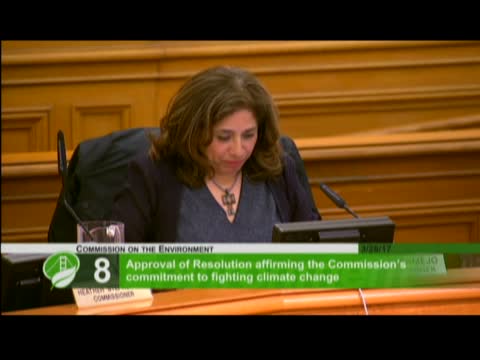
After extended public testimony that included competing claims about public‑health risks and the conservation need to control invasive plants, the San Francisco Commission on the Environment approved the Department of the Environment's 2017 reduced‑risk pesticide list on March 28 with several staff‑recommended clarifications and three friendly amendments.
Chris Geiger, the citywide integrated pest management (IPM) program manager, summarized the recommended changes: clearer advanced notification (improved signage and the addition of simple maps on postings), stricter demarcation for areas treated with Tier 1 products (roping or marking where feasible), a clarified definition of "designated public paths," and operational clarifications distinguishing broadcast spraying from targeted daubing. Geiger said the program has already reduced Tier 1 herbicide use substantially: "in the first year of these restrictions the citywide figure was an 81% reduction in these herbicides of concern, Tier 1 herbicides," he said.
Public comment was large and sharply divided. Opponents of pesticide use warned of health and environmental risks from glyphosate and other herbicides, urged far larger buffers around children's play areas, and asked the commission to pursue pesticide‑free parks. Supporters, including natural‑areas restoration staff and volunteer habitat stewards, said targeted herbicide use is sometimes the only practical tool to protect remnant native grasslands and to control invaders such as oxalis; several field gardeners described operational constraints and urged staff discretion under the IPM framework.
Commissioners discussed implementation details and accepted three friendly amendments during final action: 1) reinstate an explicit statement that all treated areas must be clearly posted, 2) clarify that blue indicator dye is required for spray treatments except where posting is not otherwise required by law (examples cited in discussion included median strips or ornamental stone areas), and 3) change wording in the section on areas frequented by children to reduce ambiguity (replace "or" with "and" after "playgrounds" in the relevant sentence). The motion to adopt the list was moved by Commissioner Wald and seconded by Commissioner Stevenson; the full measure with amendments carried by voice vote.
The resolution and attachments set a work plan for the coming year to develop better public notification tools (including electronic notifications), refine signage and mapping, and continue to explore practicable restrictions for city agencies. The department committed to return to the commission with progress reports and additional recommended changes following further interagency work and public input.
What happens next: The adopted 2017 list takes effect for city agencies’ pesticide use pending the workplan items; staff will continue to test alternatives, improve notification, and report back to the policy committee.