Get Full Government Meeting Transcripts, Videos, & Alerts Forever!
Get email alerts on the Electric Vehicle Readiness topic
No spam. Unsubscribe anytime.
Commission backs EV‑readiness ordinance and praises digital outreach campaign
Summary
The San Francisco Commission on the Environment voted to support a proposed Electric Vehicle Readiness Ordinance and heard a staff presentation on a short digital campaign that drove about 1,100 landing-page views in 3.5 weeks. Commissioners and the public pressed for measures to promote car‑share use and charging infrastructure.
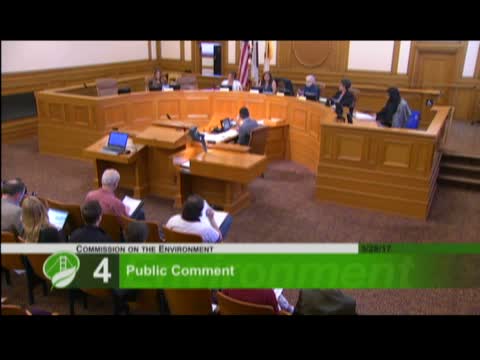
The San Francisco Commission on the Environment on March 28 voted to approve a resolution supporting the city's proposed Electric Vehicle Readiness Ordinance after a staff presentation describing recent outreach and the ordinance's technical approach.
Department outreach lead Luke Esdell presented the digital campaign "Alternative vehicles, not alt facts," saying the three-and-a-half-week effort generated roughly 1,100 page views and sustained engagement on a landing page that aggregated federal, state and local rebates. "Alternative vehicles, not alt facts," Esdell said. "The facts about buying an electric car, there's nothing alternative about them." He noted the campaign emphasized environmental motivations and directed users to links about tax credits ("the federal government offers a tax credit of up to $7,500 for now").
The ordinance staff brief, delivered by Barry Hooper, described a policy aimed at preparing buildings for future EV demand rather than immediately installing chargers. Hooper said the proposal requires electrical service sized so at least 20 percent of parking spaces could be simultaneously served by Level 2 charging and that a minimum share (roughly 10 percent) of spaces be fully wired with a charger-ready circuit; additional parking would be provisioned with empty conduit to simplify later installation. He said the approach balances near-term cost and long-term flexibility and cited state and private funding opportunities, including a Volkswagen settlement tranche for California and PG&E rebate programs.
Commissioners and public commenters asked how the ordinance would encourage car-share vehicles and whether the campaign produced measurable sales lifts. Staff said direct attribution of vehicle purchases to the short campaign is not possible but that the landing page included embedded links to rebate pages and that rebate-claim data could be analyzed as an imperfect proxy. Commissioner discussion urged the Board of Supervisors and implementing agencies to consider incentives for car‑share fleets and to coordinate EV messaging with infrastructure planning.
The commission approved the resolution supporting the ordinance by voice vote. The resolution, as discussed in the hearing, is intended to communicate the commission's formal support to the Board of Supervisors and to align the department with citywide electrification goals.
What happens next: The ordinance is expected to be taken up by the Board of Supervisors; department staff and commissioners said they will continue coordinating outreach, infrastructure planning and interagency work to link the readiness standard with parking policy and charging deployment.