Get Full Government Meeting Transcripts, Videos, & Alerts Forever!
Get email alerts on the Strategic Plan topic
No spam. Unsubscribe anytime.
San Francisco Department of the Environment unveils five-year strategic plan focused on climate protection, resilience and community action
Summary
The Department of the Environment presented a proposed five-year strategic plan to the Commission on the Environment that centers on five cross-cutting pathways, a simplified mission and a set of performance measures; commissioners pressed staff on funding, prioritization and how the plan will be used to guide resource decisions, while members of the public urged stricter herbicide limits.
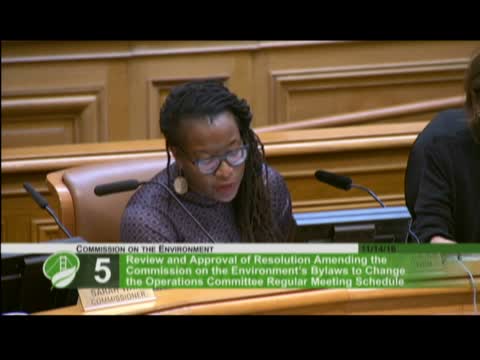
At a meeting of the San Francisco Commission on the Environment, department staff presented a proposed five-year strategic plan, describing a streamlined mission and five cross-cutting pathways intended to guide the department’s work and engagement through 2020.
The proposed mission, as explained by Donnie Olivera, reads: “The Department of the Environment provides solutions that advance climate protection and enhanced quality of life for all San Franciscans.” Olivera said the plan is meant to be a “living document” with direction and boundaries and to be updated as technologies and city needs evolve.
The plan outlines five pathways: promoting healthy communities and ecosystems; achieving a carbon‑free future; strengthening community resilience; eliminating waste; and amplifying community action. Presenters said each goal contains up to seven objectives and several measurable indicators. As one example of an aspirational target discussed in the presentation, staff cited a 40 percent greenhouse‑gas reduction by 2025 and a pathway toward larger reductions by 2050; the plan also flags metrics such as megawatt reductions from energy programs and participation in the commercial benchmarking ordinance.
Consultants from Meister Consultants Group and FM3 described the planning process as a mix of internal workshops, stakeholder interviews and benchmarking across two dozen cities. Lucia Del Pupo of FM3 summarized survey and interview results, saying stakeholders repeatedly described the department as “innovative, national leader, collaborative, forward thinking” and noted strengths in staff commitment and cultural competence.
Commissioners welcomed the plan’s clarity and cross‑cutting framing but sought sharper detail on implementation. Commissioner Wald asked how the commission and staff intended to use the plan for resource allocation and decision making; Wald said strategic plans she’s used historically were also tools to guide funding and set priorities. Director (referred to in the record as Debbie / Rafael) said staff have a detailed back‑end database and gap analyses that will be used to assign responsibilities, prioritize actions, and identify funding needs, and that the department intends to return annually with updates.
Several commissioners pressed staff on prioritization and performance milestones. Commissioner Stephenson asked whether strategies are presented in priority order; staff responded that objectives are more prioritized than the strategy list and that the department intends to set near‑term milestones and annual reporting to track progress. Commissioner Hoyos suggested using a simple red/yellow/green framework to indicate which items are ready, which need extra work, and which require sustained effort.
Staff also proposed a community engagement “roadshow” of 6–8 workshops in 2017 to surface neighborhood and affinity‑based input and asked commissioners to help host and curate those events. Commissioners volunteered to participate and asked for clearer expectations about roles and how workshops will influence the final plan and work plans.
Public commenters generally supported broad community engagement. In public comment, Anastasia Glickstern urged the commission to ban Tier 1 and Tier 2 herbicides from city park use and pressed the department to adopt a stricter precautionary approach on pesticides; that request was recorded in the public record but the transcript does not show a formal departmental commitment to an immediate ban.
Next steps described by staff include continued internal work to finalize objectives and key performance measures, integrating metrics used in city reporting, piloting community workshops and returning to the commission with annual updates and funding gap analyses. The department also signaled it will coordinate with partner agencies on measures that hinge on cross‑departmental responsibilities, such as pesticide policy and building decarbonization.