Get Full Government Meeting Transcripts, Videos, & Alerts Forever!
Get email alerts on the Transportation Demand Management topic
No spam. Unsubscribe anytime.
Commission endorses transportation-demand-management ordinance and asks to be included in standards development
Summary
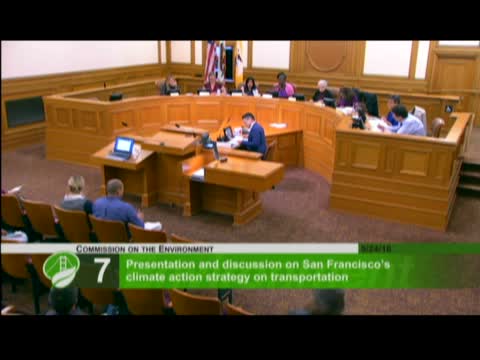
The Commission reviewed a draft Transportation Demand Management (TDM) ordinance tied to vehicle-miles-traveled targets for new development, adopted a resolution urging adoption and successfully moved an amendment urging Planning Commission standards be developed in consultation with the Department of the Environment.
Planning and SFMTA staff presented a proposed Transportation Demand Management (TDM) ordinance (the 'shift' component of the Transportation Sustainability Program) that would require new development to meet VMT-reduction targets linked to the number of on-site parking spaces. Wade Whitgraf (Planning Department; SEG 3165/8) described a point-based menu of 26 measures (bicycle parking, unbundled parking, car-share spaces, neighborhood-specific measures, membership offerings) that developers could select to meet targets. The ordinance includes pre-occupancy compliance checks, annual reporting and periodic audits; a development application fee and an annual compliance fee are proposed to fund administration.
Commissioners discussed neighborhood-specific targets, how points are assigned, coordination across city agencies and staffing/funding to carry out compliance. Commissioner Wald moved an amendment asking that the Department of the Environment be included as a collaborating agency in developing Planning Commission standards for the program; the amendment was seconded and passed after a brief public-comment period. The full resolution (as amended) was then adopted by the commission, directing staff to continue interagency coordination and participate in standards development.