Get Full Government Meeting Transcripts, Videos, & Alerts Forever!
Get email alerts on the Pesticide Policy topic
No spam. Unsubscribe anytime.
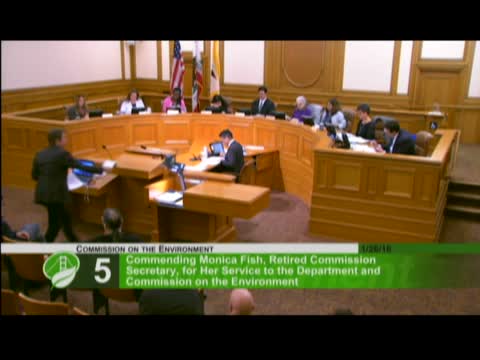
San Francisco panel narrows pesticide rules, adopts time-limited reduced‑risk list after heated public comment
Summary
After hours of public testimony and technical briefing, the San Francisco Commission on the Environment adopted an amended 2016 reduced-risk pesticide list that tightens use restrictions on Tier 1 herbicides, adds contractor and posting requirements, and requires staff to report back to the policy committee before the commission revisits the list on March 22, 2016.
The San Francisco Commission on the Environment voted late Tuesday to adopt an amended 2016 Reduced‑Risk Pesticide List (RRPL) that places stronger limits on the city's use of the most hazardous herbicides while directing staff to return with implementation details before the commission's March meeting.
Director Deborah Raffel told the commission the packet before members is “not a list” alone but a set of methodologies and safeguards developed over years: a combination of prioritization, restrictions and training to reduce pesticide exposures while preserving agencies’ ability to respond to public‑health emergencies. IPM Program Manager Chris Geiger said the city’s tiered screening system has removed the most problematic products over time and that the new packet “spells out in much greater detail than we used to where they can still use these products.”
Geiger highlighted changes staff recommended after the International Agency for Research on Cancer (IARC) classified glyphosate as a probable carcinogen in 2015. “When we learned last March that the International Agency for Research on Cancer had categorized this as a probable carcinogen, we knew this was big and we took this very seriously because this is a weight‑of‑evidence scientific determination,” he said.
Public testimony at the meeting was lengthy and sharply divided. Residents, scientists and community advocates described repeated herbicide treatments in park natural areas and warned of possible health and ecological harms. “Please ban the use of tier 1 herbicides for any reason in our public parks,” said Victoria Haman, a longtime San Francisco resident. Other speakers representing conservation organizations and park managers argued some invasive plants—for example, Oxalis in San Bruno Mountain and Glen Canyon—are not amenable to hand removal and that targeted herbicide applications are occasionally necessary to protect native habitat.
Commissioners focused discussion on the decision criteria in Attachment C of the packet—specifically how staff and pest managers will decide that use of a Tier 1 herbicide is “necessary.” Several commissioners argued the criteria were too broad and urged language to ensure the standard is applied narrowly. Commissioner Wald proposed adding a qualifying word; the commission agreed to insert the word “significant” into criterion 10 and to add the word “risk” after the first instance of “fire hazard.” The commission also asked staff to strengthen contractor training and posting requirements after citing recent problems with unclear signage.
With those edits, the commission voted to adopt the RRPL as amended and to set a short review timeline: the packet will be in effect until the commission revisits it at its March 22, 2016 meeting, with an implementation update provided to the policy committee in March. The measure passed by voice vote; the approved motion also instructed staff to pursue additional oversight measures, including evaluation of direct on‑site supervision by licensed applicators for Tier 1 uses.
What happens next
The amended packet imposes immediate new obligations on contractors and requires more detailed posting and mapping of treatment sites. Staff said they will begin implementing the revised posting requirements and vendor briefing rules, start annual trainings for staff who apply pesticides, and conduct a short vetting across city departments to determine the availability of licensed applicators. The commission scheduled a policy‑committee follow up in March and will reconsider the RRPL on March 22, 2016. If commissioners decline to reconfirm the revised packet at that later meeting, the previous year's list remains in effect until a new version is adopted.
Speakers and evidence
Key staff who spoke: Director Deborah Raffel; Chris Geiger, Integrated Pest Management Program Manager. Public speakers who testified on health or ecological harms included Victoria Haman, Pat Skene, Dee Seligman and others. Experts supporting the program’s processes included Igor Lachan (UC Cooperative Extension advisor) and Jake Sigg (California Native Plant Society).
Why it matters
The vote attempts to square competing public values: a precautionary approach to human and ecological health and a biodiversity/ habitat management agenda that sometimes relies on herbicide tools to control aggressive invasive plants. The commission adopted new procedural safeguards and a short review window to allow staff and stakeholders to address remaining operational questions before the rules become final.