Get Full Government Meeting Transcripts, Videos, & Alerts Forever!
Get email alerts on the Solid Waste topic
No spam. Unsubscribe anytime.
Department updates Commission on proposed Recology Hay Road landfill agreement; fees, diversion incentives and 0‑waste account explained
Summary
Staff presented the negotiated disposal agreement with Recology’s Hay Road landfill, including a base tipping rate proposal ($22.73 plus county fees — currently $30.32 total), tiered sustainability and excess‑disposal fees that feed a dedicated 0‑waste account, and a 1% reserve surcharge capped at $10M; the agreement now moves to the Board of Supervisors for review and a 30‑day appeal period.
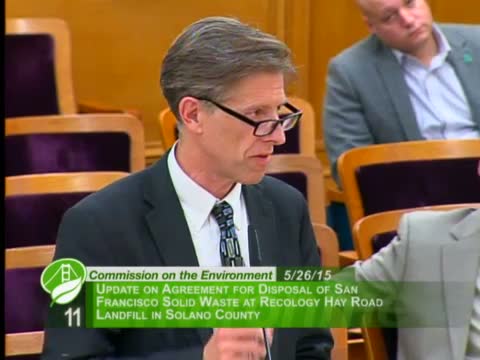
Department staff updated the Commission May 26 on the status of the proposed San Francisco solid‑waste disposal agreement with Recology’s Hay Road landfill in Solano County.
Jack Macy, commercial 0‑waste coordinator, walked through the procurement history: the city ran a competitive process that compared Recology and Waste Management proposals; Recology’s base landfill operations bid was $22.73 per ton with county government fees currently adding $7.59, which Macy said yields a current total of $30.32 per ton under the proposed agreement. The original long‑term Altamont contract approaches exhaustion of its permitted cumulative tonnage, prompting the procurement.
Macy described contract design features intended to support the city’s zero‑waste goals: a table of annual disposal targets with an "excess disposal" fee of $5 per ton assessed on tonnage above the target; a Sustainability Fee structure that charges more for loads containing organics (e.g., $15 where organics are present vs. $10 for organics‑free waste) to incentivize processing and removal of organics; and a dedicated 0‑waste account to fund diversion, processing and emissions‑reduction projects. Macy said the 0‑waste account and fees would be governed by criteria jointly determined by the Department and Recology and that some fee elements may require separate Board of Supervisors approval or rate‑process steps.
The agreement also includes a reserve fund mechanism funded by a 1% surcharge on solid‑waste collection, capped at $10 million, to handle unplanned costs between rate proceedings. Staff outlined the CEQA and permitting path: the Planning Commission upheld a negative declaration for hauling impacts after one appeal; the Department expects to forward the agreement to the Board of Supervisors for hearings and an additional 30‑day appeal period, with Board action targeted for July if possible.
Public comment and commissioners raised questions on litigation risk, hauling distance versus ratepayer cost, and local hiring opportunities; staff said opportunities exist to prioritize local hiring at new processing facilities and that diversion investments typically yield more local jobs per ton than landfill operations. No action was required at this informational item.