Get Full Government Meeting Transcripts, Videos, & Alerts Forever!
Get email alerts on the Pesticide Policy topic
No spam. Unsubscribe anytime.
Commission adopts revised reduced‑risk pesticide list and asks staff to analyze phasing out Tier 1 herbicides in parks
Summary
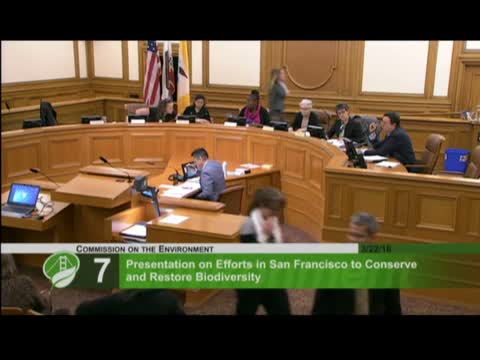
On March 22 the San Francisco Commission on the Environment approved a revised 2016 reduced‑risk pesticide list with new restrictions on Tier 1 herbicides and added a directive asking the Department of the Environment to produce an analysis outlining a pathway to significantly reduce or phase out Tier 1 herbicides (including a possible two‑year phase‑out in public parks).
SAN FRANCISCO — The San Francisco Commission on the Environment voted March 22 to adopt the Department of the Environment’s 2016 reduced‑risk pesticide list with new restrictions on the city’s most hazardous herbicides and added a formal request that staff analyze how the city might significantly reduce — or phase out — Tier 1 herbicides in public parks.
The package that the commission approved added operational limits and transparency measures intended to cut overall herbicide use. Department staff proposed a ban on purely cosmetic applications, a 15‑foot buffer from most public paths, contractor training and oversight, mandatory use of a blue indicator dye to mark treated plants, new posting and barrier requirements around treated areas, and a requirement that licensed applicators directly supervise certain on‑site treatments after a six‑month implementation window.
"We are the toxics‑reduction program — we try to reduce toxics every day," said Chris Geiger, the Department’s Integrated Pest Management program manager, describing the department’s review process and the new restrictions. "This package is intended to whittle away the uses that are approved for these products while preserving tools to address public‑safety and infrastructure concerns."
The vote followed hours of public comment and testimony from city agencies. Public commenters pressed the commission to prohibit Tier 1 products such as glyphosate (commonly sold as Roundup) and Garlon, citing health concerns, the World Health Organization’s prior classification of glyphosate as a probable carcinogen and a precautionary‑principle argument.
"Please ban the Tier 1 herbicides," said Victoria Hammond, a physician and neighborhood resident who said the state’s classification had driven local concern. "People are asking if their cancer was caused by Roundup."
City agencies and land stewards urged caution about any blanket prohibition, saying targeted, limited herbicide use remains an operational necessity in some contexts. Dina Noonan, the IPM coordinator at San Francisco International Airport, told the commission that certain airfield and safety tasks cannot be managed safely through manual or mechanical methods alone and that herbicide options remain critical for runway visibility and worker safety.
"It would have significant ramifications at the airport," Noonan said, describing federal airfield requirements that limit mechanical options and the safety risks of other approaches.
Tim Ramirez, manager for the Public Utilities Commission natural resources team, added that the PUC manages tens of thousands of acres beyond the city proper and sometimes relies on targeted treatments when other methods fail.
To address both sets of concerns, commissioners approved an amendment that asks the Department of the Environment to present an analysis to the full commission that "outlines a pathway to significantly reduce the use of Tier 1 herbicides, including the possibility of a phase‑out within two years in public parks, and for all areas where these herbicides are used by the City and County of San Francisco." The amendment also asks for an implementation update to the commission’s Policy Committee at its November 2016 meeting.
Director Deborah Raphael framed the amendment as a straightforward request for analysis rather than an immediate ban. "We can come back with the analysis — what does a two‑year path look like, what would be required, and what are the trade‑offs in labor, budgets and operational constraints," she said.
Supporters of the department’s package noted citywide reductions in pesticide use over previous years and cited the city’s long‑running IPM process. Rec & Park and Public Works IPM coordinators described extensive manual, mechanical and experimental alternatives (sheet mulching, steaming, mechanical removal, targeted injection and trials of less‑toxic products) and said the new restrictions would further reduce higher‑risk uses.
Opponents told the commission those measures do not go far enough and urged a firm moratorium or a short, binding phase‑out timetable for Tier 1 products in parks. Proponents of keeping targeted herbicide options warned that a rapid blanket ban could compromise worker safety or critical infrastructure operations if alternatives were not fully resourced.
The commission approved the revised 2016 reduced‑risk pesticide list and the amendment requesting the analysis. The Department of the Environment will report implementation progress to the Policy Committee at its scheduled November 2016 meeting and will present the requested analysis to the full commission.
What’s next: the commission’s request requires staff to map alternatives, resource needs and timelines for reducing Tier 1 herbicide use in parks and across other city‑managed lands, and to return with recommended implementation steps and identified constraints.