Get Full Government Meeting Transcripts, Videos, & Alerts Forever!
Get email alerts on the Transportation topic
No spam. Unsubscribe anytime.
Panel tells San Francisco Commission that electric vehicles and charging infrastructure are central to climate goals — but multi‑unit housing and funding remain
Summary
A May 26 Commission deep dive featured NRDC, Bay Area Air District and Greenlining Institute speakers who said EVs are essential to decarbonizing light‑duty transport, highlighted equity programs (Charge Ahead/SB1275) and urged city action on EV‑ready buildings and targeted outreach; staff and commissioners pressed on infrastructure for multi‑unit dwellings and incentive effectiveness.
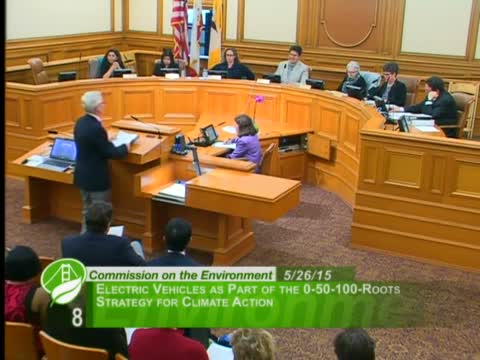
San Francisco’s Commission on the Environment held a focused discussion on electric vehicles (EVs) on May 26, exploring how EV deployment fits the city’s “50/100” climate strategy and what local policy steps could accelerate adoption.
Speakers from the Natural Resources Defense Council, the Bay Area Air Quality Management District and the Greenlining Institute described the technical and equity rationales for accelerating EVs. Roland Wang of NRDC framed EVs as a core element of a three‑part decarbonization strategy — energy efficiency, decarbonized electricity and electrified transportation — and said the light‑duty vehicle sector will ultimately need a near‑zero‑carbon electricity supply. "We have to move to eventually 100% of the light duty vehicle transportation needs to be fueled on some sort of 0 carbon, electricity derived fuel," he said.
Regional Air District staff highlighted current market data and programs: the Bay Area accounts for a large share of California EV sales but EVs still make up only a small share of the total fleet; the Air District has incentive programs, is investing in charging infrastructure and plans to expand heavy‑duty incentives. The Air District recommended building codes that require EV stub‑outs and charging readiness for new construction and major renovations.
Sakita Grant of the Greenlining Institute urged policies that lead with equity: higher rebates or increased incentives for low‑ and moderate‑income households, financing options, car‑sharing pilots for disadvantaged communities, and supplier/inclusive hiring in the clean‑transport sector. She cited SB 1275 (Charge Ahead) and the set‑aside expectations for cap‑and‑trade funds as program tools to steer investment toward communities most affected by pollution.
Commissioners pressed panelists on two recurring challenges: multi‑unit dwellings (where residents lack private charging access) and the business case for publicly available chargers. Panelists noted tools (utility proposals before the PUC, Air District infrastructure grants) and analytic tools (UC Davis/ARB calculators) that can help jurisdictions and residents evaluate total cost of ownership.
Panelists and commissioners identified practical city actions: require EV‑ready infrastructure in new developments, increase city fleet electrification to show leadership, and fund targeted outreach programs to ensure funds reach disadvantaged communities. The discussion concluded without action; staff said the presentation would inform future policy committee work.