San Francisco Ethics Commission unanimously approves four stipulations over late filings and incompatible activity
Loading...
Summary
At its June 14 meeting the Ethics Commission unanimously adopted stipulations resolving four enforcement matters involving late Form 700 filings and one inspector's board service that agency staff said created an appearance of incompatibility. Commissioners approved all motions 3-0 following staff presentations and public comment.
The San Francisco Ethics Commission on June 14 unanimously approved four stipulation-and-order settlements in matters where staff found commissioners or other public officials failed to meet disclosure or training requirements.
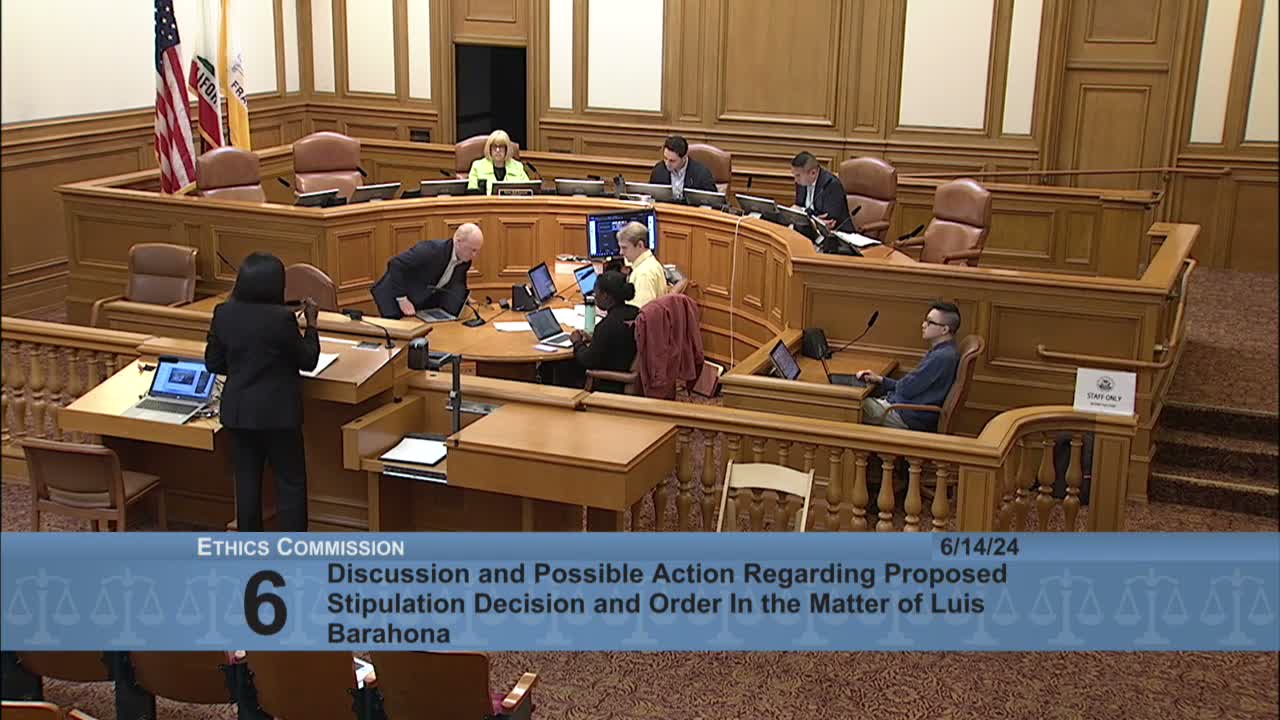
BC Matthews, the Commission's director of enforcement, told commissioners the cases involved failures to timely file required disclosures or to complete required trainings, plus one matter in which a Department of Building Inspection senior housing inspector served on the board of an organization (TNDC) that his department inspected. Matthews said there was no evidence the inspector received income from the board role but that serving on the board while inspecting TNDC properties created an incompatibility with department policies and warranted a penalty recommendation.
"Respondent was directly involved in inspecting and making decisions on properties owned or managed by TNDC while serving on the board of TNDC," Matthews said, summarizing the Barahona matter.
Investigator Eric Willett described outreach and notice efforts in the Form 700 matters, saying the engagement and compliance division sent five notices and the enforcement division sent additional communications; Willett said staff ultimately tracked eight total communications to the respondents and made phone contact in at least one case.
Commissioners asked procedural questions about whether existing notification processes were operating effectively and whether other city bodies should be alerted when a member is out of compliance. Matthews and other staff pointed to an existing code provision that assigns the clerk or secretary of commissions the duty to notify members regarding filing compliance, and to the division's practice of sending multiple electronic notices and follow-ups.
Public comment included repeated complaints from a San Francisco resident and mayoral candidate, who alleged broader election-interference problems and criticized the Commission's approach; another caller, John Soderstrom, suggested adding certified mail as an additional method in some notice sequences to create a paper trail. Staff acknowledged that certified mail can provide a stronger record but explained their routine practice relies on email and phone, supplemented by direct outreach when email responses are not received.
The Commission voted on each matter after public comment. Recorded motions and roll calls showed unanimous approval (3-0) for:
- Adoption of the executive director's report (motion carried 3-0). - Adoption of the remainder of the consent calendar (items 3 and 5) (motion carried 3-0). - Item 6: Adoption of the stipulation and order in the matter of Luis Barahona (motion carried 3-0). - Item 7: Adoption of the stipulation and order in the matter of Murrell Green (Form 700 violations) (motion carried 3-0). - Item 8: Adoption of the stipulation and order in the matter of Thomas Harrison (motion carried 3-0). - Item 9: Adoption of the stipulation and order in the matter of Deneen Hadley (motion carried 3-0).
Matthews said one relevant code provision currently prevents assessing a monetary penalty on a separate disclosure-count where the code does not permit such sanctions; staff recommended penalties where permitted and explained how penalty amounts were calibrated using the Commission's penalty guidance (SARP) and other factors including public harm and cooperation with the investigation.
The Commission did not identify any additional sanctions beyond the stipulated dispositions discussed at the meeting. Commissioners asked staff to continue reviewing notification processes to reduce the risk that disqualified commissioners participate in votes without their status being flagged in advance. Staff indicated the engagement and compliance division already sends routine notices and that the matter of improving inter-agency notifications could be addressed in subsequent agenda items.
The meeting record shows the enforcement actions were adopted and the Commission adjourned at the end of the session.