Get Full Government Meeting Transcripts, Videos, & Alerts Forever!
Get email alerts on the Campaign Finance Regulations topic
No spam. Unsubscribe anytime.
Ethics Commission approves campaign finance regulation changes, including electronic registration and clarified subpoena language
Summary
The commission approved amendments to modernize electronic filing (eliminating a separate pre‑signature verification), standardize safe‑harbor attestations, close a home/office fundraiser loophole for prohibited contributors, clarify bank‑account rules, and add language to treat failure to timely respond to subpoenas as withholding.
The San Francisco Ethics Commission voted unanimously to approve a package of amendments to its campaign finance regulations that staff said will modernize electronic filings, standardize several rules and strengthen enforcement clarity.
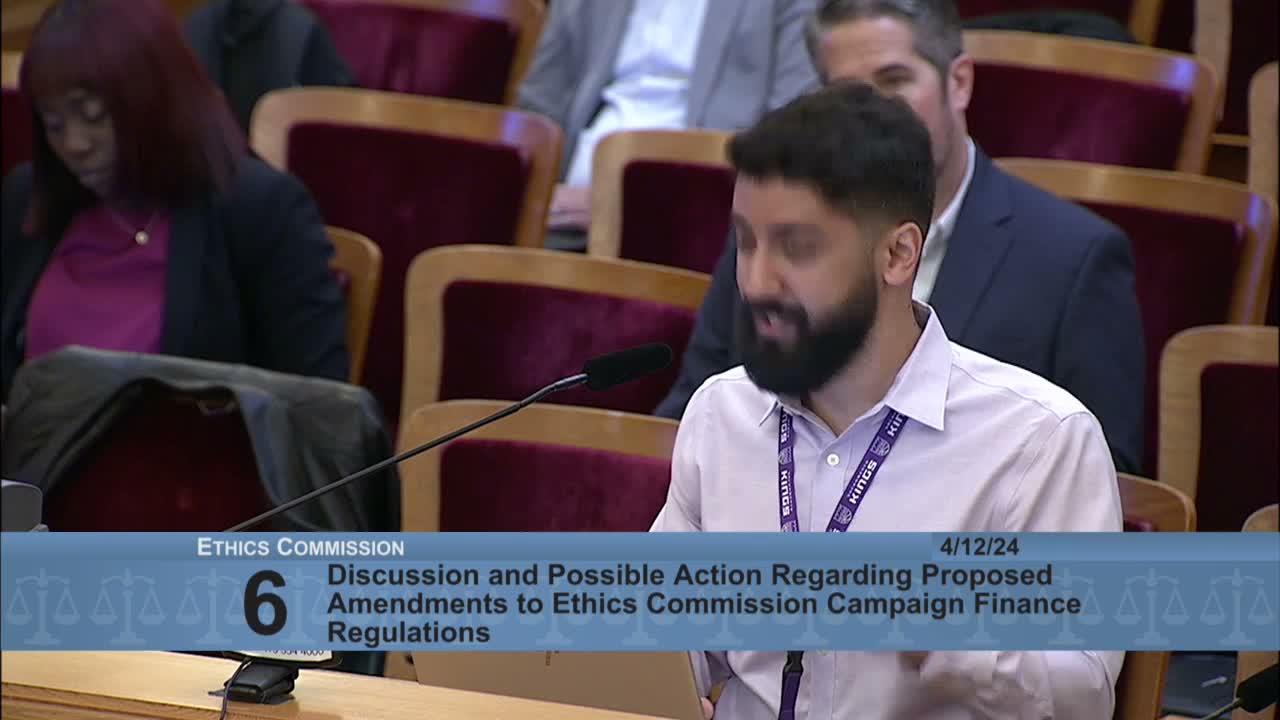
Staffer Ryan Abusa told commissioners the package’s principal change would remove the separate pre‑signature verification (form 112a) and replace it with an expanded online committee registration form (akin to Oakland’s form 300). Under the proposal, committees would register online, designate signer authority and sign under penalty of perjury, allowing full electronic filing without the prior requirement of an in‑person or notarized step. Abusa said the Secretary of State’s office and the Fair Political Practices Commission had reviewed the approach and found it acceptable.
Other changes the commission approved include a clarification of how the commission interprets a committee officer’s bank location (to include banks authorized to do business in the City and County of San Francisco, even if accounts are established online), standardization of safe‑harbor attestation language for candidate committees, and new rules aimed at preventing prohibited contributors from using home or office fundraisers as a workaround to contribution bans.
Commissioners pressed staff on implementation details and practical concerns for small committees. One commissioner asked whether the proposed rules would short‑circuit legitimate objections to subpoenas; staff and legal counsel agreed to a verbal edit to proposed regulation 1.17‑2 to clarify that failure to provide materials “requested pursuant to a subpoena from the Ethics Commission, or a timely response to such a subpoena,” would constitute withholding. The chair moved to adopt the package with that verbal edit; the motion passed on a 4–0 roll call.
The commission instructed staff to publish the adopted language and proceed with the statutory notice period for those rules that require it (staff noted one regulatory change would trigger a 60‑day notice period before implementation), so some changes could be active within roughly 60 days of adoption depending on the rule.