Get Full Government Meeting Transcripts, Videos, & Alerts Forever!
Get email alerts on the Ethics Gift Reform topic
No spam. Unsubscribe anytime.
San Francisco Ethics Commission hears department testimony and nonprofit warnings as it weighs tighter gift rules
Summary
At a special remote hearing, the San Francisco Ethics Commission discussed proposed ballot language and regulation changes that would expand restricted-source rules and increase liability for gift givers; city department officials urged clarifying ticket exceptions while nonprofits warned of a chilling effect and asked for a racial equity review.
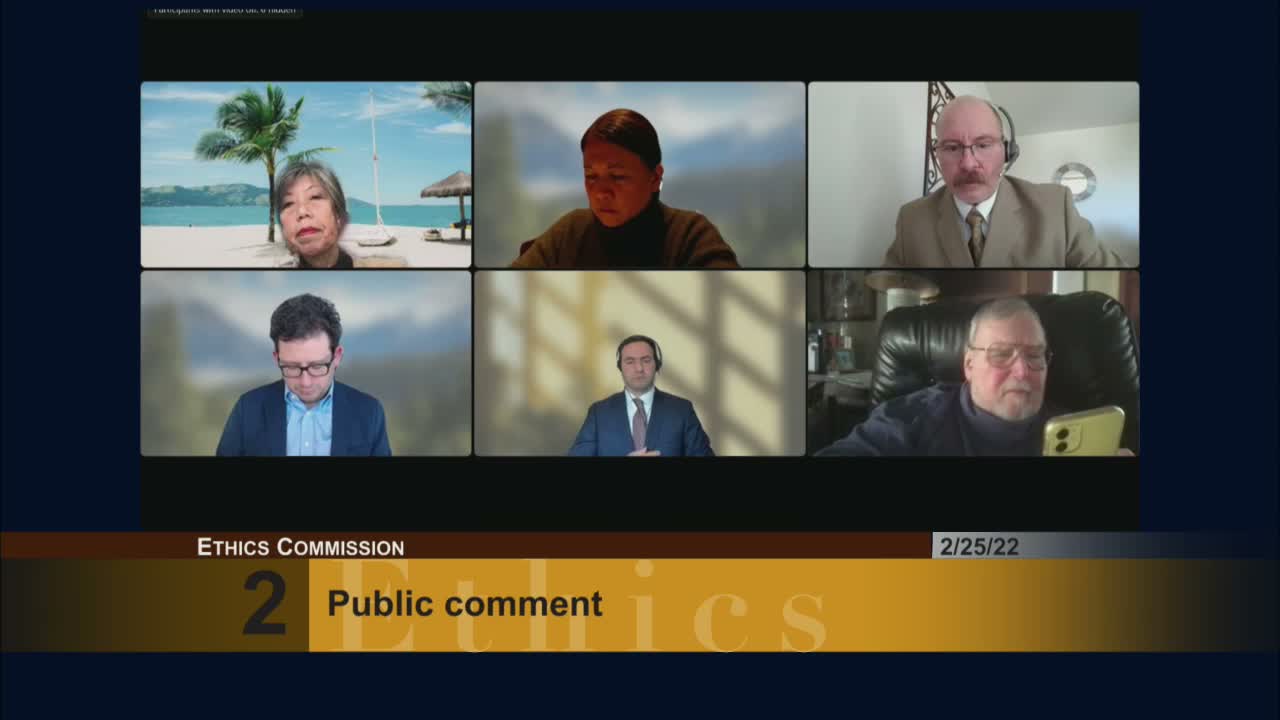
The San Francisco Ethics Commission held a special remote meeting to gather public comment and department testimony on proposed amendments to the city's gift and ethics code and companion regulations, including a potential ballot measure for the June election (meeting date not specified).
Chair Lee opened the session by describing the proposals'objectives: to clarify and expand the restricted-source rule, strengthen the city's "scribe" rule and require more officials to complete annual ethics training. Commissioners later paused debate on the draft rules to take a closed session on labor negotiations and returned to continue public testimony.
Department testimony highlighted the technical and operational importance of current exceptions. John Calden, managing director of the San Francisco War Memorial, told commissioners the Fair Political Practices Commission (FPPC) treats certain gratis tickets given for official monitoring as not being gifts when distributed under an official ticket-distribution policy and reported on Form 802. Calden said his department holds back a limited number of seats for city use, uses a ticket-distribution policy to document public purpose, and already reports tickets publicly; he urged the Commission to build on that existing process rather than create a new, broader prohibition.
Commissioners pressed Calden on details including whether a "plus-one" is necessary, ceilings on ticket allotments and how the de minimis rule should work. Staff and counsel confirmed the existing de minimis threshold differs from the proposal: historically a $25 exception has existed, while staff'drafted regulations would describe a narrower $15 routine-office-courtesy exception.
Public commenters and a large number of nonprofit representatives said the draft measure, as written, would cast a wide net and impose compliance burdens that could discourage small, community-based organizations from partnering with city agencies. Mary Kate Bacalau of Compass Family Services, Kaushik Roy of Shanti Project and other callers urged the Commission to conduct a racial equity analysis and to preserve or clarify exceptions for nonprofit fundraisers, small office courtesies, holiday acknowledgments and unpaid board members.
"There has still not been a racial equity scan of this proposed ordinance," said Shawn Rosen Moss of the Department of the Environment, echoing multiple callers who said the measure could have a disproportionate impact on BIPOC-led organizations. Several nonprofit leaders said their mission-driven work and fragile budgets make compliance and additional reporting particularly onerous.
Commissioners acknowledged those concerns and asked staff to refine options. After extended public comment, the Commission adopted a motion (5-0) expressing appreciation for public input and controller reports and directing staff to continue meet-and-confer outreach and present refined options for future Commission consideration; the motion did not lock the Commission to a specific ballot date.
The Commission also took two formal votes tied to meeting procedure: it voted to enter closed session to consult a labor negotiator about the measure and then, after the closed session, voted not to disclose the closed-session discussions.
What happens next: commissioners directed staff to incorporate the day's feedback into revised regulatory options and to return with materials that spell out specific exceptions and interpretations (for example, the ticket exception and what constitutes a routine office courtesy). The Commission left open the option of forwarding a finalized ordinance to the ballot once staff and commissioners have had additional opportunity to refine language and consider equity impacts.