Get Full Government Meeting Transcripts, Videos, & Alerts Forever!
Get email alerts on the Ethics Ballot Measures topic
No spam. Unsubscribe anytime.
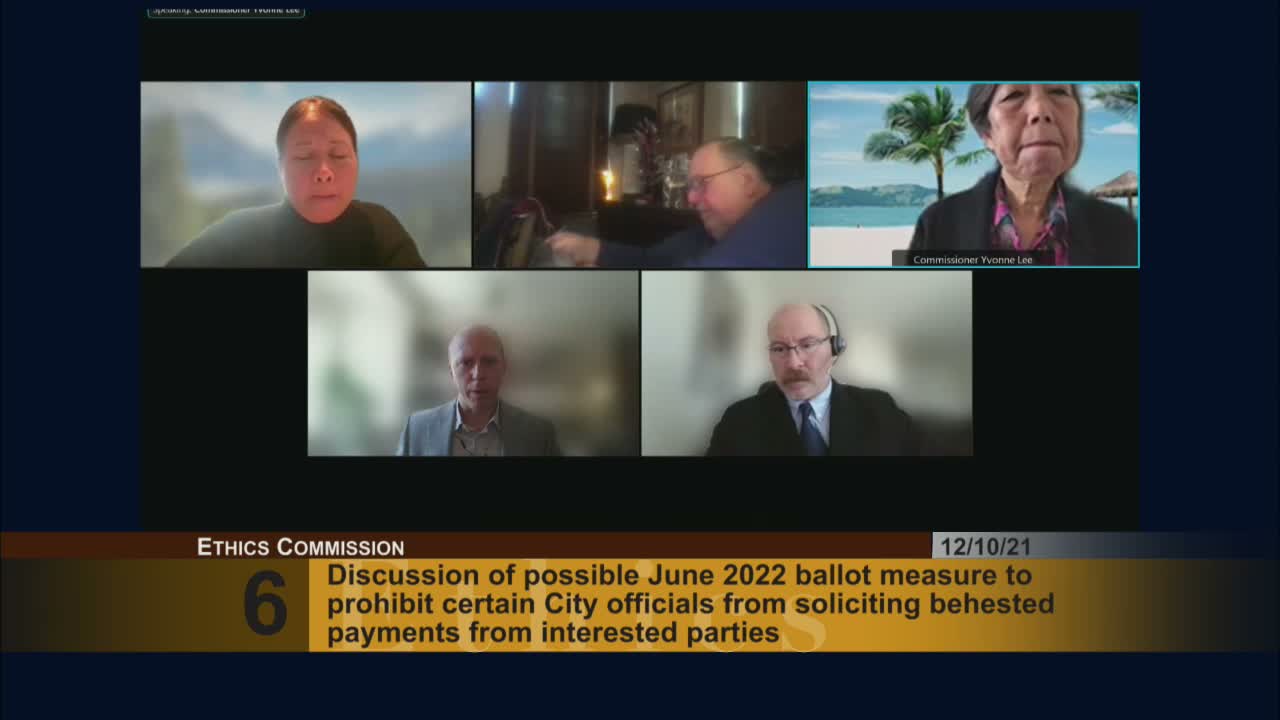
Ethics Commission hears extensive staff briefing on gifts and behe sted payments, delays action to January
Summary
After presentations on proposed behe sted-payment rules and comprehensive gift-law reforms, the San Francisco Ethics Commission agreed to continue formal action to January so departments and stakeholders can review draft measures; staff said the Board of Supervisors has a largely similar behe sted-payments ordinance.
The San Francisco Ethics Commission on Dec. 10 heard a multi-hour staff briefing on two related measures the agency is considering for the June 2022 ballot — one limiting behe sted (be hested) payments and another rewriting the city’s gift and core ethics provisions — and agreed to defer action until a January meeting to allow more stakeholder review.
Pat Ford, the commission’s senior policy and legislative counsel, told commissioners the Board of Supervisors has already passed a version of a behe sted-payments ordinance on first reading that largely mirrors the commission’s draft and recommended the ethics panel “continue the discussion of this item until the January meeting so that you can see what action the board takes next week” and what, if any, mayoral response follows. Ford summarized an extensive package of phase‑2 (gifts) and phase‑3 (essential ethics provisions) recommendations, saying the package strengthens the city’s bribery definition, creates penalties for failing to disclose personal and professional relationships, expands mandatory ethics training to all Form 700 filers, and standardizes incompatible‑activity rules across departments.
Museum and nonprofit leaders called for more time. “We ask that the Commission postpone any any fundamental action on item 6 and 7,” said Jason Seifer, chief financial officer of the Fine Arts Museums of San Francisco, noting museums rely heavily on 501(c)(3) partners and had received roughly 200 pages of proposed changes in a short window. Robert Mintz, deputy director of the Asian Art Museum, echoed that request and asked the commission to wait so departments and nonprofits can review the drafts.
Several commissioners also urged a fuller hearing and outreach. Commissioner Bell praised staff work and said he wanted to “hear the tizz and the taint today” and then give stakeholders time to respond before voting. Deputy City Attorney Shen advised that submitting a measure for the June 2022 election would require action about 95 days before the election, in early March, giving the commission “at least 2½ more months” to decide whether to proceed.
Ford and staff said many of the code changes being proposed would require voter approval to insulate certain chapters from unilateral legislative amendment and to harmonize penalty and e‑filing provisions across the campaign and governmental conduct code. Staff also recommended continued meet‑and‑confer discussions with municipal unions and departments; the commission agreed that further outreach and a January follow‑up are appropriate. The commission did not take a final vote on either item and formally continued both items to its January meeting.